Can I Extend a Supercharger Cable? The AC-vs-DC Line You Can't Cross

TL;DR
No, you cannot extend a Supercharger or any DC fast-charger cable. DC fast cables carry hundreds of amps of direct current, and high-power ones use liquid cooling in the handle itself; an AC Level 2 extension cannot carry that current or that heat. The station's safety electronics perform insulation and continuity checks at plug-in and will refuse power when an unsupported cable is detected. If you keep running short at public DC fast chargers, the fix is repositioning the car or picking a stall with a longer cable.
Which situation describes you?
Pick the row that matches what you drove up to today.
| Your situation | What to do |
|---|---|
| Tesla owner, the Supercharger cable falls a few feet short of your car's charge port | No extension exists for this. Pull the car forward, back it in, or move to a stall with better geometry. Tesla's charging documentation prohibits extensions on both the Mobile Connector and Wall Connector, and the Supercharger is tighter still. |
| 2025+ Ford, GM, Rivian, or Hyundai/Kia NACS vehicle at an Electrify America NACS stall that doesn't quite reach | No. The NACS connector physically fits AC and DC, but DC fast-charging cables are a different piece of hardware. Reposition the car or pick a different stall. |
| CCS1 J1772 Combo DC fast-charging station (Chevy Bolt, older Mach-E, ID.4, etc.) | No. Different connector family than NACS, same answer. The cable architecture is built for DC current the extension market does not serve. |
| Public AC Level 2 pedestal (ChargePoint CT4000, EVgo AC, workplace J1772) | Possibly, but check first. A UL 2263 cable rated at or above the pedestal's output can work electrically. Most station operators prohibit third-party extensions on their equipment, so read the posted terms. See the extension buyer's guide for the broader taxonomy. |
| At home, your own AC Level 2 EVSE won't reach the parking spot | This is the situation an extension actually solves. See the J1772 fit guide or NACS extension buying guide depending on your connector. |
How to tell DC fast charging from AC Level 2 at a glance
The question matters because the answer flips on which one you're using. Three quick checks let you identify what's in front of you without opening a manual.
| Check | AC Level 2 pedestal | DC fast charger |
|---|---|---|
| Advertised speed | 6-19 kW, charge times in hours | 50-350 kW, charge times in minutes |
| Cable thickness | Flexible, roughly garden-hose diameter | Thick, stiff, often with a visible cooling line, hard to coil |
| Session cost | Free, flat fee, or $0.10-0.30/kWh | $0.40-0.60/kWh, often with time-based idle fees |
Why AC Level 2 cables and DC fast-charging cables aren't interchangeable
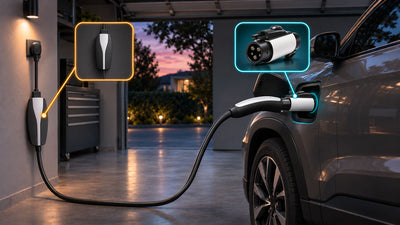
The connector on the end hides the real difference. A NACS plug looks the same on a Supercharger and on your garage wall, which is where the misconception comes from. The cable behind the plug is a different machine.
An AC Level 2 cable carries alternating current at 240 volts and 32-80 amps. Residential-grade EV cables use conductors in the 10 AWG to 6 AWG range with silicone or TPE jacketing, and heat dissipates through the jacket by natural convection. A 50-foot run at 50 amps is well within what flexible cable can handle at ambient temperature.
A DC fast-charging cable carries direct current at 400-1000 volts and anywhere from 125 amps on the low end up to 500+ amps on 350 kW stations. At those currents, uncooled conductors would need to be too thick and heavy to handle, so station builders cool the cable actively. High-power DC cables run a coolant loop through the handle and the first several feet of cable, with a reservoir and pump inside the dispenser. That's why a 350 kW cable is stiff and heavy and why you can sometimes hear the station humming.
An extension product cannot replicate the cooling loop. It cannot be rated for 500 amps DC. And it is not within the certification scope of UL 2263, which covers EV cable stock for AC Level 2 charging and does not address DC fast-charging architecture. There is no equivalent certification for a DC fast-charging extension because the physical and thermal problem has not been solved at the extension price point.
What happens if you try anyway
Even setting aside the thermal problem, you wouldn't get the chance. DC fast-charging stations perform a startup handshake before any power flows, and that handshake is defined in the SAE J3400 NACS standard and the CCS specifications it borrowed from.
At plug-in, the station checks three things in sequence. It verifies the control pilot signal is present on the correct pin. It performs an insulation resistance test between the DC conductors and the chassis of the vehicle. And on NACS and CCS alike it verifies that the proximity signal matches the connector type the vehicle expects.
Any extension inserted between the station and the car creates an open-circuit discontinuity on at least one of those paths. The pilot signal picks up resistance it shouldn't have. The insulation test sees capacitance that doesn't belong in the expected range. The station logs a fault, displays an error on the screen, and refuses to initiate the charging session. The car does not charge.
Station operators treat that fault log as a tamper indicator. Repeated faults from the same account can lead to account suspension on networks like Tesla, Electrify America, and EVgo. Nothing about this is quiet.
What actually solves a short-reach problem at a DC fast charger
The good news is that reach problems at public DC fast-charging stations are almost always a parking problem, not a hardware problem. The cables are engineered to reach every charge-port location on the vehicles the station is built for, which means the stall and the vehicle have to be lined up correctly.
Pull the car forward or back it in. Most reach failures at Superchargers happen because the car is parked with the charge port on the far side of the stall. A V3 Supercharger cable is about 7 feet of working length and a V4 cable is longer; either reaches a correctly parked vehicle.
Move to an adjacent stall. Supercharger stalls are often numbered A and B on shared power cabinets, and switching from a congested side can give the cable a cleaner angle. Electrify America, EVgo, and ChargePoint DC stations typically have two or more cables per dispenser.
Pick a station on your route with longer cables. The Tesla trip planner and the manufacturer's own navigation apps (Ford, Rivian, GM, Hyundai) know which stations have the newer, longer-cable V4 Superchargers or 350 kW DC fast chargers. If you repeatedly hit short-cable stations, let the planner weight toward the newer sites.
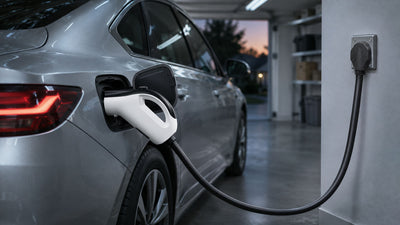
If the reach failure is at home rather than on a trip, the fix is a different one. A properly rated AC Level 2 extension is the correct product for a home garage layout, and a portable Level 2 charger with its own 25-foot cable can relocate the inlet-side of the equation entirely.
Which WenStorm product helps if you keep hitting reach problems on the road
This article does not recommend any extension product for use at DC fast chargers. The product WenStorm sells for the readers who keep running into reach problems is the home charger below, so you depend on public DC fast charging less often rather than trying to make it work from awkward angles.

When an extension cord is NOT the right fix
Here are the scenarios where no product in the WenStorm catalog, and no product on the open market, is the correct answer.
- Any Tesla Supercharger stall where the cable falls short. There is no extension that is safe or permitted on a Supercharger cable.
- Any Electrify America, EVgo, or ChargePoint DC fast-charging dispenser, including the NACS pedestals rolling out in 2025 and 2026.
- CCS1 J1772 Combo DC fast-charging stations serving a Chevy Bolt EUV, an older Mustang Mach-E, a VW ID.4, or any other CCS1 vehicle. The connector family is different from NACS but the DC fast-charging constraint is identical.
- Any station where the on-screen error reads "insulation fault" or "pilot fault" after you plugged in. That is the station's safety electronics working as designed, and the fix is not a different cable.
- Any situation where the car is parked with the charge port on the far side of the stall. Reposition first; most reach failures resolve this way.
- Public AC Level 2 pedestals where the operator's posted terms prohibit third-party cables. Workplace charging agreements and city-run pedestals often do.
- At-home DC fast-charging equipment of any kind. Residential DC fast chargers exist (DCC-10, Autel MaxiCharger DC, Wallbox Supernova Home), and none of them support cable extensions.
Related reading
- The J1772 extension cable fit guide for home AC Level 2 setups.
- The NACS extension cord buying guide for Tesla and 2025+ NACS vehicles charging at home.
- The EV extension cable buyer's guide for the full taxonomy of when extensions are and aren't appropriate.
- Tesla Gen 2 Mobile Connector adapter decision matrix for Tesla owners sorting out their home charging options.
Frequently asked questions
Can I use a J1772 extension cord on a CHAdeMO or CCS DC fast charger if the connector physically fits with an adapter?
No. The connector family matters, but what makes extensions unworkable at DC fast chargers is the cable itself, not the connector. An adapter plus an AC-rated extension would still fail the station's insulation and continuity check, and no adapter changes the fact that the extension cable isn't rated to carry hundreds of amps of DC current.
What about low-power DC fast chargers in the 25-50 kW range?
Same answer. Lower-power DC fast chargers don't use liquid cooling in the handle, but they still deliver 100-200 amps of DC through a cable architecture that no consumer extension product is built or certified to extend. The station's startup handshake refuses an unsupported cable in the loop.
Tesla sells a Supercharger "mobility kit" or similar — is that an extension?
No such product exists in Tesla's current catalog. Tesla sells the Mobile Connector (an AC Level 2 EVSE for home use), the Wall Connector, and various adapters, and the charging support documentation explicitly prohibits extension cords on all of them. Nothing in the Tesla lineup extends a Supercharger cable, and if a third-party listing claims to, it isn't a Tesla product.
If physical fit is possible, why does the station know to refuse?
Because the station doesn't just send power when the plug clicks in. It runs a startup sequence that includes a control pilot handshake, an insulation resistance test, and a proximity signal check, all defined in the SAE J3400 and IEC 61851 standards. An extra cable in the circuit changes the electrical signature the station expects to see, and the station refuses to proceed. This is the same category of safety check that prevents a station from energizing a damaged cable.
Where to verify these claims
Primary sources for the technical claims in this article:
- Tesla charging documentation prohibits extension cords on the Mobile Connector, Wall Connector, and Supercharger: tesla.com/support/charging.
- SAE J3400 NACS standard (December 2023) for the connector specification and station handshake sequence: saemobilus.sae.org.
- UL 2263 covers EV cable stock for AC Level 2 charging only: ul.com.
- NEC Article 625 for installed EV charging equipment context: nfpa.org.
- Alternative Fuels Data Center on charging levels: afdc.energy.gov.