Which Tesla Dryer Outlet Adapter Do You Need? NEMA 14-30 vs 10-30
$43.99 for the NEMA 14-30, $44.59 for the older 10-30. Both work with the Tesla Gen 2 Mobile Connector. Here's which one fits your outlet.

TL;DR
For a modern 4-prong dryer receptacle, use a Tesla Gen 2-compatible NEMA 14-30 adapter; for a legacy 3-prong receptacle, use a NEMA 10-30. Tesla documents 24A / 5.7 kW on either adapter — about 22 mi/hr on a Model 3, 21 mi/hr on a Model Y (actual range added varies with vehicle, temperature, and battery state). WenStorm's third-party 14-30 ($43.99) and 10-30 ($44.59) versions fit the Gen 2 Mobile Connector only — not Gen 3 or J1772 chargers. Identify your outlet by its actual receptacle pattern, not by house age.


NEMA 14-30 vs NEMA 10-30 at a Glance
| Question | NEMA 14-30 | NEMA 10-30 |
|---|---|---|
| Receptacle | 4-prong | 3-prong |
| Typical status | Current / common dryer configuration | Legacy dryer configuration |
| Voltage | 240V | 240V |
| Breaker | 30A | 30A |
| Tesla Gen 2 max current | 24A | 24A |
| Tesla Gen 2 power | 5.7 kW | 5.7 kW |
| Model 3 published rate | up to 22 mi/hr | up to 22 mi/hr |
| Separate equipment ground | Yes (4-wire: L1 / L2 / neutral / ground) | No separate equipment-grounding conductor (3-wire: L1 / L2 / neutral) |
| Tesla official Gen 2 adapter available | Yes | Yes |
| WenStorm Gen 2 version | Yes — $43.99 | Yes — $44.59 |
Sources: Tesla Mobile Connector Support for current and mi/hr; Tesla Gen 2 Mobile Connector Owner's Manual for 24A / 5.7 kW rating.
Identifying Your Dryer Outlet
The receptacle face is the only reliable identifier. Home age is not — remodels, appliance replacements, and legacy installations frequently break the "1996 rule."
- NEMA 14-30: four-prong receptacle with two hot conductors, a neutral, and a separate equipment-grounding conductor. Common in newer dryer installations.
- NEMA 10-30: legacy three-prong dryer receptacle with two hot conductors and a neutral, and no separate equipment-grounding conductor. Tesla's own 10-30 installation guide documents the three-wire configuration.
- Not sure? Count the holes on the receptacle face; look for the "14-30R" or "10-30R" marking stamped on the receptacle body. Do not guess from the age of the house or from the wiring behind the wall.
What Each Adapter Actually Does
Each adapter is a short physical converter that plugs into your dryer receptacle on one end and accepts the Tesla Gen 2 Mobile Connector on the other. Tesla's Gen 2 Mobile Connector reads the attached NEMA adapter and sets its continuous charging current to the correct value for that outlet type — 24A on 14-30 or 10-30 adapters, per the Gen 2 Mobile Connector owner's manual.
24A continuous is also the customary continuous-load capacity of a 30A branch circuit under NEC continuous-load sizing rules (NEC 210.19 / 210.20). No app changes required; the Mobile Connector applies the derated pilot signal automatically.
WenStorm's adapters are third-party accessories for the Tesla Gen 2 Mobile Connector only. They do not fit any J1772 EVSE. If you drive a non-Tesla EV and have only a dryer outlet, see our full guide to charging an EV from a dryer outlet for the electrician-install path.
14-30 vs 10-30 — Which Should You Prefer if Installing New?
If you're installing a new dryer or EV-charging receptacle today, do not choose a legacy 10-30 configuration simply because adapters exist for it. NEMA 10-30 is relevant mainly to existing legacy installations that pre-date the 4-wire code adoption. For a fresh install, a properly permitted 14-30 (or a 14-50 sized for full 32A EV charging) is the correct modern configuration.
For an existing outlet you can't easily replace: identify what is already installed and evaluate the branch circuit's condition, rather than trying to convert one receptacle type to another without checking the wiring.
Have an Old Tesla OEM Dryer Adapter? Check the 2016 Recall
NHTSA campaign 16E-091 (2016) covered 6,729 first-generation Tesla NEMA 14-30, 10-30, and 6-50 adapters. Some internal welded connections could develop increased resistance, overheating, or arcing under continuous load. NEMA 14-50 was excluded from the recall; the remedy was replacement adapters.
Tesla's current recall page lists affected OEM part numbers by SKU. Later 14-30 revisions (Tesla identifies revision 1018243-00-C) do not require replacement. If you own an older Tesla OEM adapter, look up the exact part number on Tesla's recall page — do not assume age alone determines recall status. WenStorm adapters are current-production third-party accessories and are not the recalled first-generation Tesla units.
Charging Speed You Can Expect
Tesla's support page currently lists the following rates on a Gen 2 Mobile Connector at 24A / 240V:
- Model 3 — up to 22 mi/hr
- Model Y — up to 21 mi/hr
- Model S / Model X — lower mi/hr because pack efficiency is lower; see the current Tesla model-specific figures
For an eight- to ten-hour overnight session, that adds enough range to cover typical daily driving for most owners. Actual range added varies with vehicle, temperature, cabin pre-conditioning, and battery state — Tesla's figures are maxima at nominal 240V supply. If you need higher rates, upgrade to a NEMA 14-50 outlet and use the WenStorm NEMA 14-50 adapter ($59.99) or a WenStorm Level 2 Portable Charger ($219.99) for 32A continuous.
How to Install and Use
Plug the adapter into the dryer outlet. Plug the Tesla Gen 2 Mobile Connector into the adapter. Plug the NACS handle into your Tesla. Charging starts at the derated 24A rate automatically. No configuration, no app changes.
Before your first session, confirm:
- Breaker rating. Open the electrical panel, find the dryer circuit, and read the amperage stamped on the breaker handle. A 30A double-pole breaker is required.
- Dedicated branch circuit. NEC 625.40 generally requires EV charging equipment to be on an individual branch circuit; a plain shared dryer/EV circuit is not appropriate. Certain listed automatic load-management or transfer devices exist that give the dryer priority and pause EV charging when the appliance operates — see the FAQ below for the passive-splitter vs load-management distinction.
- Receptacle condition. Look for heat discoloration, cracked plastic, or a loose plug fit. Do not use a receptacle you cannot verify is undamaged and correctly installed; when in doubt, have it inspected by a qualified electrician.
Stop charging and investigate immediately if you notice abnormal or increasing heat, a burning odor, discoloration or melting on the plug or receptacle face, a loose plug fit, or repeated Mobile Connector faults. If your dryer receptacle is older or has never been inspected, have it evaluated before using it for routine EV charging.
When You Should Not Use This Adapter
- The 10-30 receptacle shows corrosion, a loose fit, or has never been inspected. A legacy 10-30 has no separate equipment-grounding conductor, so uncertain wiring is worth having a qualified electrician evaluate before nightly EV charging.
- You need more than 24A of charging. A 30A branch circuit's continuous-load capacity is 24A. For 32A or 48A rates, use a NEMA 14-50 or hardwired install with a Level 2 charger.
- The outlet is outdoors without weather protection. Standard NEMA 14-30 and 10-30 receptacles are indoor-rated. An outdoor receptacle needs a weatherproof in-use cover per NEC 406.9(B), and often GFCI upstream per NEC 625.54.
- You own an unrepaired first-generation Tesla OEM 14-30, 10-30, or 6-50 adapter (NHTSA 16E-091). Look up your OEM adapter's part number on Tesla's recall page and get the remedy before charging.
FAQ
Can I share the dryer outlet between my dryer and my Tesla?
Do not assume a passive Y-splitter makes a 30A dryer circuit suitable for both loads. EV charging and the dryer must not overload the branch circuit at the same time, and NEC 625.40 generally requires a dedicated circuit for EV supply equipment. Some UL-certified automatic load-management or transfer devices — for example NeoCharge's Smart Splitter — are designed to give the dryer priority and pause EV charging when the appliance operates. Whether that path is appropriate depends on the exact listed device, your EVSE, the adopted electrical code, and your local Authority Having Jurisdiction (AHJ). Confirm with a qualified electrician before installing.
Is the WenStorm Tesla dryer outlet adapter compatible with the Tesla Gen 3 Mobile Connector?
No. WenStorm's NEMA adapters are designed for the Tesla Gen 2 Mobile Connector interface. The Gen 3 Mobile Connector uses a different adapter socket and requires Tesla's own Gen 3 adapters. Confirm which generation of Mobile Connector you own before purchasing.
How does the adapter know to derate to 24A?
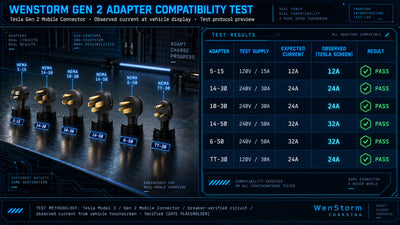
Each adapter identifies itself physically to the Tesla Gen 2 Mobile Connector on plug-in. The Mobile Connector then sets the pilot signal to the continuous current Tesla documents for that outlet type — 24A for 30A dryer outlets. The car obeys the pilot signal without any user input. This behavior is documented for Tesla OEM adapters in Tesla's Gen 2 Mobile Connector owner's manual; third-party adapters like WenStorm's are designed to trigger the same recognition, and a customer-side verification with a real Tesla screen amperage reading is the citation-worthy path (WenStorm-published test results forthcoming).
Can I use this adapter with a portable J1772 charger?
No. The adapter fits only the Tesla Gen 2 Mobile Connector's proprietary input. It will not fit any J1772 EVSE. If you drive a J1772 EV with only a dryer outlet, check your specific charger manufacturer's documentation for approved outlet configurations, or install a NEMA 14-50 or hardwired Level 2 unit.
What is the WenStorm adapter warranty?
24-month warranty from date of purchase per WenStorm's return-policy page.
What if my dryer outlet is a NEMA 14-50 or 6-50?
Different adapter. See the WenStorm NEMA 14-50 adapter for Tesla Gen 2 ($59.99) or the WenStorm NEMA 6-50 adapter for Tesla Gen 2 ($51.99).
Where can I read the safety physics behind dryer-outlet charging?
See our full guide: Can You Charge an EV From a Dryer Outlet? 14-30 vs 10-30. It covers the electrician-verify checklist and the 30A → 24A continuous-load math in more detail.
Primary sources used in this guide
- Tesla Mobile Connector Support — current 14-30 / 10-30 amperage and model-specific mi/hr
- Tesla Gen 2 Mobile Connector Owner's Manual — 24A / 5.7 kW rating and adapter recognition
- Tesla NEMA 10-30 Installation Guide — legacy three-wire configuration
- Tesla Adapter Recall (NHTSA 16E-091) — affected first-generation OEM part numbers
- Tesla Home Charging Support — outlet suitability and installation guidance
Last verified: 2026-09-09.
Real questions from EV owners
Join the EV Adapters & Connector Compatibility discussion →