"I Need a 50-Foot Extension" — Why Total Reach ≠ Added Cable Length
TL;DR
A 50-foot parking distance almost never needs a 50-foot extension. Your total reach is the EVSE's attached cable plus the extension minus a routing allowance for running the cable along a wall or over a mount. A 25-foot EVSE cable plus a 25-foot extension is 50 feet on paper, but routing eats 5-10 ft in a real garage. For a 50-foot spot, a 30 or 40-foot extension is usually the right pick. Pick 50 feet only when the EVSE outlet is at the far end of a long driveway or multi-stall garage.
Which situation describes you?
Match your parking distance from the outlet to the right length so you aren't paying for cable you'll be coiling on the floor.
| Parking distance from outlet | Recommended extension length | Why |
|---|---|---|
| 15 to 20 feet | No extension if the EVSE cable is 20 ft or more | A 25-foot EVSE cable already covers this with slack to spare. |
| 25 to 30 feet | 21-foot or 25-foot extension | 25 + 21 = 46 ft total; a routed path still clears 30 ft of actual distance. |
| 35 to 40 feet | 30-foot extension | 25 + 30 = 55 ft total; leaves 15 ft of routing allowance. |
| 45 to 50 feet | 40-foot extension | 25 + 40 = 65 ft total; absorbs a long wall-run plus a drop to the inlet. |
| 50 feet or more | 50-foot extension — or an electrician | If a straight line already exceeds 50 ft, a relocated outlet is often the better fix. |
The math: total reach = EVSE cable + extension − routing
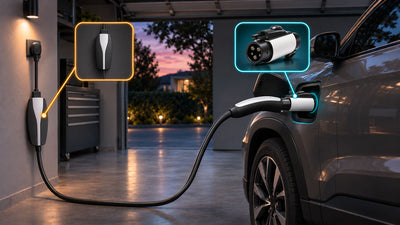
Three numbers determine whether a cable actually reaches your inlet. The attached EVSE cable, the extension length, and the routing allowance you need to run the cable in a way that is safe and not a trip hazard.
Most plug-in Level 2 chargers ship with 18 to 25 feet of attached cable. The Tesla Mobile Connector is 20 feet. The Grizzl-E Classic is 24 feet. The WenStorm Level 2 Portable is 25 feet. Confirm your model's spec sheet before buying anything.
Routing allowance is the length consumed by running the cable along a wall, around a doorway, up to a hook, or across the ceiling of a garage bay. A straight-line distance of 30 feet typically becomes 35 to 40 feet of actual cable path once you add two 90-degree turns and a mount drop.
| Scenario | Cable total | Usable straight-line reach |
|---|---|---|
| 25 ft EVSE + 21 ft extension | 46 ft | ~34 to 38 ft after routing |
| 25 ft EVSE + 30 ft extension | 55 ft | ~42 to 46 ft after routing |
| 25 ft EVSE + 40 ft extension | 65 ft | ~50 to 55 ft after routing |
| 25 ft EVSE + 50 ft extension | 75 ft | ~60 to 65 ft after routing |
The pattern is consistent. Subtract 10 to 15 feet from the raw sum to get the real-world reach you can plan around. A 50-foot straight-line distance from outlet to inlet lines up with a 40-foot extension in most garage layouts, not a 50-foot one.
Why you don't want to buy 50 feet "just in case"
Buying the longest cable and coiling the excess on the garage floor is the single most common install mistake in EV charging. Three things go wrong when a current-carrying cable is coiled on itself.
Heat has nowhere to escape. The TPU jacket on a 50A J1772 extension is engineered to shed heat into surrounding air, with an operating range of −30 to +50°C. A tight coil holds the inner conductors against each other and traps that heat. The NFPA National Electrical Code addresses this risk for installed wiring under NEC 310.15(B)(3)(a) conductor bundling adjustments; the physics is the same for flexible cables.
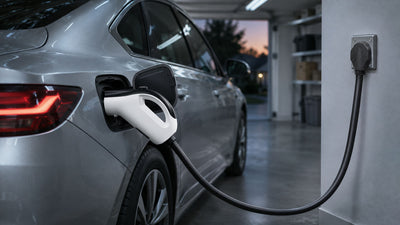
A coil on the floor is a trip hazard. Garage floors double as walking paths to the trash, to the storage shelf, to the laundry. A loose 20-foot coil at the base of the car is a fall waiting to happen, especially at night.
Lastly, coiled cable degrades faster. Repeatedly bending the same section at the same point past the manufacturer's minimum bend radius work-hardens the copper and cracks the jacket. Buy the length you need, not the length you might.
When 50 feet is actually what you need
The 50-foot variant has a legitimate home. These are the three setups where it's the right pick instead of over-buy.
Multi-stall garages where the EVSE is on the opposite wall. A three-car garage can easily exceed 40 feet corner-to-corner, and if the outlet is on the far wall, 40 feet of extension may still come up short after routing.
Driveways with the only exterior outlet at the house's far corner. Older homes often have one weatherproof outlet near the side door that happens to sit 45 to 55 feet from where the car parks. If a licensed electrician's estimate for a new 240V circuit to the parking area is prohibitive, the 50-foot extension is the stopgap.
Apartment and condo shared garages where you were assigned a stall that isn't adjacent to the outlet. Policy sometimes locks you into a specific stall; the extension lets you reach the shared or in-unit EVSE without renegotiating the parking assignment.
Beyond 50 feet, call an electrician
WenStorm's longest extension is 50 feet, in both J1772 and NACS. That isn't an arbitrary cap. Longer flexible EV cable has three compounding problems: voltage drop climbs, cable mass and cost scale non-linearly, and SAE J1772 communication reliability depends on signal integrity across the pilot pair.
If your straight-line distance exceeds 50 feet, the right fix is almost always a new 240V branch circuit to a point near the parking spot. A licensed electrician can pull wire through walls, conduit, or buried runs where a flexible extension cannot go. The one-time installed cost is typically $600 to $2,000 depending on panel capacity and run length, and the result is a dedicated outlet that doesn't live on the floor.
Which WenStorm cable to buy
For the common 45 to 50-foot straight-line scenario, the 40-foot J1772 variant is the usual answer, not the 50-foot. The buy-box below shows the 50-foot variant because it is the correct pick when your layout genuinely requires it; the shorter variants are available on the same product page.

If you drive a Tesla or any NACS-equipped vehicle and are charging AC Level 2 at home, the equivalent product is the WenStorm NACS Extension Cord in 50 ft at the same price. Note that Tesla's own documentation prohibits extensions on the Tesla Mobile Connector and Wall Connector; the NACS extension is intended for third-party NACS EVSEs that permit extensions. Read your charger's manual before use.
When a 50-foot extension is NOT the right fix
Several common setups look like they need 50 feet of extension but actually point to a different solution.
- Your attached EVSE cable is already 25 feet and your parking spot is 25 feet away. A 21-foot extension is enough; a 50-foot gives you 25 feet of coil on the floor.
- You have a hardwired wall-mounted EVSE such as a Tesla Wall Connector. Tesla prohibits extensions on the Wall Connector — relocating the unit or extending the branch circuit is the correct path.
- Your parking spot is on the other side of a wall from the outlet. Running an extension through a doorway or window seasonally is a workaround; permanent wall penetration should be done with conduit and a new outlet.
- The outlet is in a different building. A cable crossing a driveway or lawn between structures is at risk of damage and may violate local electrical code; this is a job for a buried branch circuit.
- You park outdoors with no sheltered path for the cable. UV, snow, and vehicle tire pressure will shorten a flexible cable's lifespan regardless of length.
- You haven't confirmed your EVSE allows extensions. Some non-Tesla manufacturers also publish extension restrictions in their current manuals — read yours before buying anything.
- You don't know the attached cable length of your EVSE. Measure it before ordering an extension; buying blind is how you end up with 20 feet of excess coil.
Related reading
- EV extension cable buyer's guide — the umbrella article covering NEC 625.17(C) and the full compatibility picture
- J1772 extension cable fit guide — plug and inlet physical fit before you worry about length
- NACS extension cord buying guide — the Tesla / NACS equivalent and its specific restrictions
- NACS vs J1772 in a multi-EV household — picking the right standard when you have both vehicle types
Frequently asked questions
Can I daisy-chain two extensions to get 100 feet of reach?
No. Chaining EV extension cables stacks voltage drop, doubles the number of connection points that can heat up, and voids the manufacturer's warranty on both cables. If 50 feet of extension plus your EVSE cable still doesn't reach, the setup is signaling that the outlet needs to move closer to the car.
Does using a 50-foot extension slow down charging?
Voltage drop at a 50-foot length and 50A load is modest on properly sized conductors — the WenStorm 50A variant uses 2×8 AWG specifically to keep drop under spec. The practical charging speed is set by the EVSE, the vehicle's onboard charger, and the breaker, not the extension. If you see slower-than-expected charging with an extension in line, inspect the plug-receptacle fit on both ends before suspecting the cable.
Can I use a J1772 extension on a Tesla with the J1772 adapter?
Only if the EVSE on the wall allows extensions. The J1772 adapter changes the connector shape, not the policy — if your charger is a Tesla Mobile Connector or Tesla Wall Connector, the adapter does not change Tesla's extension prohibition for that EVSE. For a third-party J1772 charger that permits extensions, the J1772 extension plus the Tesla J1772 adapter is a supported combination.
Should I just buy the 50-foot and leave the extra coiled up?
No — this is the mistake the whole article is written to prevent. A coiled current-carrying cable traps heat, becomes a trip hazard, and work-hardens the conductors over time. Match the length to the routed path, not to a worst-case guess.
Where to verify these claims
Primary sources are linked inline above. Short bookmark list for the load-bearing references:
- Tesla Mobile Connector support documentation — attached cable length and extension policy
- U.S. DOE Alternative Fuels Data Center — EV charging at home — Level 2 EVSE basics
- NFPA 70 National Electrical Code — Article 625 covers EV supply equipment installation rules
- SAE J1772 standard — the connector specification referenced throughout
- UL — standard 2263 covers EV cable stock; WenStorm cable stock is certified UL-US-2407470-0