Charging an EV on a 100-Amp Panel Without a $4,000 Upgrade (2026)

TL;DR
Yes — a 100-amp panel can run Level 2 EV charging in most homes, once you match the charge rate to what's left after your existing appliances draw their peak. A 16–32A portable charger plugged into an existing 240V outlet costs about $220 and needs no permit; a smart splitter that shares a circuit with your dryer or range runs $700–900. A full 100A → 200A service upgrade is $2,500–4,000, only necessary if your peak baseline load already sits above ~50A.
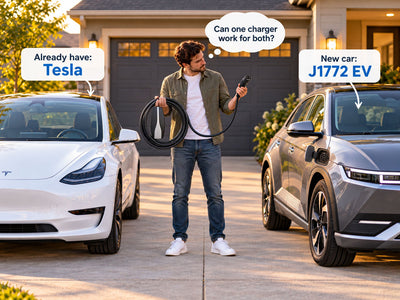
Your electrician quoted $3,500 to upgrade your panel before you can install a Level 2 EV charger. You've been talking yourself out of the EV for two weeks. Here's the part most electricians don't lead with: you can charge an EV on a 100-amp panel today, in most homes, for under $250 in hardware and zero permit fees. The trick is understanding what your panel actually has available, then choosing a charging setup that fits inside that number.
This guide walks the real math, shows you the three workarounds ranked by cost, and tells you honestly when you should just do the upgrade.
Why 100-amp panels can't handle a "standard" 48-amp EV charger
The National Electrical Code (NEC) treats EV charging as a "continuous load" — meaning a load that runs for three or more hours at a stretch. Under NEC 210.19 and 210.20, continuous loads must be sized at 125% of the actual current draw, or looked at from the other direction, a circuit can only carry 80% of its breaker rating continuously.
A 48-amp home Level 2 charger needs a 60-amp dedicated circuit. Do the math from the other side: 60A × 0.80 = 48A continuous. That works electrically, but it also means you've allocated 60% of a 100-amp panel's total capacity to one appliance. Most 100A homes already run:
- Electric dryer — 24-30A while running (NEMA 14-30 or 10-30 circuit)
- Electric range or oven — 30-40A while cooking (NEMA 14-50 or hardwired)
- Central AC — 15-30A while cooling
- Electric water heater (if fitted) — 18-25A while heating
Any two of those firing at once already puts you at 45-60A. Add a 48A EV charger and you'll trip the main breaker — that's the physics your electrician is worried about.
The way out is not upgrading the panel. The way out is running a smaller EV load. A 16A or 24A charge session pulls dramatically less headroom, doesn't require a new dedicated circuit in most cases, and adds enough range overnight for the driving 90% of US commuters actually do.
The load calculator: what's actually available on your panel

Before spending a dollar on hardware, do this ten-minute audit. Turn on everything that runs simultaneously during your household's peak load hour — usually 6-8pm on a summer weekday or a winter evening. Then open your electrical panel and read the amp clamp on your main service conductors, or read your utility's smart meter app if you have one.
If you don't have a clamp meter or smart meter, add up nameplate ratings for what's typically on:
| Appliance | Typical draw when running | Runs during peak? |
|---|---|---|
| Central AC (3-ton) | 15-20A | Yes in summer |
| Electric heat pump | 20-30A | Yes in winter |
| Electric dryer | 24-30A | Not usually simultaneous with AC |
| Electric range (2 burners + oven) | 25-35A | Only during dinner prep |
| Electric water heater (tank) | 18-25A | Cycles on/off |
| Refrigerator, lights, misc | 5-10A | Constant |
Take your baseline (constant load) plus the two heaviest appliances you'd run at the same time. That's your realistic peak. Subtract from 100A × 0.80 = 80A continuous capacity.
Worked example. A three-bedroom house with central AC (18A), electric water heater (average 5A cycling in and out), refrigerator + lights + electronics (8A baseline), electric dryer (28A when running): peak simultaneous = 18 + 5 + 8 = 31A always on, up to 59A when the dryer starts. Continuous headroom for EV charging: 80 − 31 = 49A available most of the time, dropping to 21A while the dryer is actively drying.
That house can charge at 32A most of the night if the dryer isn't running, and 16A while the dryer is running. It cannot charge at 48A simultaneously with the dryer without tripping something.
That math points to the fix.
The three workarounds, ranked by cost

1. Adjust your vehicle's charge current + plug into a 240V outlet you already have — $220
Every modern EV lets you dial down the charging amperage in the vehicle's app or on the touchscreen:
- Tesla: Settings → Charging → Charge Current, adjustable 5-48A
- Ford (Mach-E, F-150 Lightning): FordPass app → Charge Settings → Charging Amperage
- Chevy Bolt / Bolt EV: Energy → Charging → Location & Limits → Max Charge Rate
- Rivian (R1T, R1S): Center screen → Vehicle → Charging → Current
- Hyundai / Kia (Ioniq 5, EV6, Niro EV): EV Menu → Charging Limits → Home Charging Current
- Volkswagen ID.4 / Audi e-tron: MyVW app → Charge Settings
Set it to 16A, 24A, or 32A depending on your available headroom. Then plug in a WenStorm Level 2 Portable EV Charger ($219.99) into any existing 240V outlet — a dryer NEMA 14-30, a range NEMA 14-50, or an RV park NEMA TT-30 with a WenStorm adapter.
The WenStorm draws up to 32A max, but the car controls the actual current. Set the car to 24A, it draws 24A. Set the car to 16A, it draws 16A. That's how you fit a full Level 2 charger inside a smaller circuit budget — the charger is a passive conduit, the car is the throttle.
When this works: you have any existing 240V outlet you can plug into (dryer, range, RV park, welder). You have headroom of at least 16-32A during your normal charging window (usually overnight when other appliances are off). Your car supports current adjustment in the app or menu (every EV sold in the last 5 years does).
When this doesn't work: your only 240V outlets are hardwired to appliances you can't unplug (like a wired-in electric range) and there's no receptacle to share. See workaround 2.
2. Smart splitter — share one circuit between your EV and dryer/range — $700-900 + install
Smart splitters ("automatic transfer switches" in code language) let two 240V appliances share a single circuit. When the dryer runs, the EV charging pauses. When the dryer finishes, the EV picks back up. Only one draws power at a time, so you never exceed the circuit's rating.
The two products currently on the market:
| Product | Price | Compatible with | Install |
|---|---|---|---|
| Splitvolt Splitter Switch | ~$700 | NEMA 14-30, 14-50, 6-50 outlets | Plug-in, no permit |
| NeoCharge Smart Splitter | ~$900 | NEMA 14-30, 14-50, 10-30 | Plug-in, no permit |
Neither requires an electrician for a plug-in install — they land between your existing outlet and the two appliances. If you want it hardwired, budget $200-400 for a licensed electrician.
Choose Splitvolt if: you have a NEMA 6-50 outlet (welder or older EV install) or you want the lower price. It's the more established brand for shared 14-50 setups.
Choose NeoCharge if: you have an older 3-prong NEMA 10-30 dryer outlet. NeoCharge supports it; Splitvolt doesn't.
When smart splitters work: you have a dedicated 240V outlet for an appliance (dryer, range) that you rarely use at the same time you'd charge. You don't want to run new wire from your panel. You accept slower average charging because the splitter pauses your EV whenever the dryer starts.
When splitters don't work: you have simultaneous heavy loads that both need to run during the charging window. Charging automatically pauses too often to be useful.
3. Full panel upgrade + hardwired Level 2 — $2,500-4,000
If your existing baseline load already exceeds 50A during peak, or you're planning to add more electric appliances (heat pump, induction range, electric water heater), the panel upgrade is what your electrician quoted for a real reason. A 100A → 200A service upgrade typically runs:
- Utility disconnect and reconnect: $200-500 (charged by your utility, not the electrician)
- New meter socket + main breaker panel: $800-1,500
- Labor and permit: $1,000-2,000
- New 200A service entrance conductors from meter to panel: $300-800
Total: $2,500-4,000 in most metro markets, more in California or the Northeast.
Once the panel is done, a hardwired 48A Level 2 charger runs another $500-800 in equipment + $300-500 in labor to install a 60A dedicated circuit.
When to actually do this: see the next section — it's honest about when the upgrade is the right call.
When you actually do need a panel upgrade (the honest edge cases)
The three workarounds above cover most 100A-panel households. But there are real scenarios where trying to avoid the upgrade will cost you more than doing it:
- You're already electrifying the whole house. Adding an EV to a home that's converting from gas to electric everything (heat pump, induction range, heat-pump water heater, EV) will push you over 100A even with load management. Upgrade the panel while the electrician is already there — you save on a second service call.
- Your existing panel is fully populated with no available slots. A 20-slot panel with 20 breakers already installed leaves no room for a new dedicated EV circuit even if there's electrical headroom. Sometimes the fix is a subpanel; sometimes it's a service upgrade.
- Your service entrance wire is aluminum from the 1970s. These are approaching end of useful life anyway. If your electrician mentions "aluminum feeders" or "corroded lugs," the upgrade fixes long-term risk you'd be dealing with in five years regardless of the EV.
- You have a two-car EV household and both drive 50+ miles daily. Two cars each needing to recover 50 miles overnight at 16A each will push you close to the panel's continuous limit. Either upgrade or install a two-port load-managed charger.
- Your utility offers a rebate that closes the gap. Con Ed, PG&E, PSEG, and about a dozen other utilities offer $500-2,000 panel upgrade rebates specifically for EV owners. Check your utility's EV incentive page — if the rebate is $1,500+, the upgrade math changes.
Everyone else: workaround 1 or 2 is real, safe, code-compliant, and vastly cheaper.
NEC compliance per workaround
The whole point of continuous-load rules is preventing overheated conductors and receptacle fires. All three workarounds are code-compliant when installed correctly:
- Vehicle-side current limiting + existing outlet. The circuit already exists and is rated for whatever appliance it was installed for. Reducing the EV's draw below the outlet's continuous rating is legal and safe. Verify the outlet is on a dedicated circuit (nothing else runs on the same breaker) and that the receptacle is in good condition (no scorch marks, tight when you plug in). NEC 625.42 covers EVSE branch circuit sizing; the code allows any current level up to the circuit's continuous rating.
- Smart splitter. Both Splitvolt and NeoCharge are UL listed for their intended use. UL 916 covers energy management equipment; UL 2594 covers EV charging equipment. Confirm the model you buy has both markings on the spec sheet. Plug-in installation is legal in all states without permit; hardwired installation typically requires an electrical permit.
- Panel upgrade + hardwired 48A charger. Full code compliance requires a permit, inspection, and utility coordination. NEC 210.19(A)(1)(a), 210.20(A), 625.40, and 625.42 all apply. Your licensed electrician handles this.
What to buy — hardware recommendations
For workaround 1 (the cheapest and most flexible path), the setup is:
- Charger: WenStorm Level 2 Portable EV Charger 32A NEMA 14-50 with 25-ft cable — $219.99. Plugs into any 240V NEMA 14-50 outlet. J1772 or NACS versions available depending on your vehicle.
- Adapter (if your existing outlet is a dryer NEMA 14-30): WenStorm keeps a range of NEMA adapters compatible with the Tesla Gen 2 Mobile Connector for Tesla owners. For non-Tesla EVs on a NEMA 14-30 dryer outlet, look at aftermarket adapters rated for continuous 24A use.
- Adapter for 3-prong dryer NEMA 10-30 (older homes): See WenStorm's guide to charging from an older dryer outlet. This is a common 1970s-1990s home outlet configuration.
- Adapter for TT-30 RV park outlet (if you ever travel): WenStorm RV Park Adapter Kit TT-30 to 14-50.
For workaround 2, buy directly from the manufacturer (Splitvolt.com or NeoCharge.com). Both offer 30-day returns if it doesn't work with your specific setup.
FAQ
Can I charge an EV on a 100-amp panel at all?
Yes, in most cases. The math depends on what other appliances draw during your charging window. A typical 100A single-family home has 16-32A of continuous headroom overnight (when other appliances are off), which is enough for a Level 2 EV charger set to a matching current. Do the load calculation in section 2 before assuming you can't.
How many amps does a Level 2 EV charger actually pull?
It varies by installation. A "48-amp" home Level 2 unit is the maximum — real-world draw is whatever your vehicle asks for, and every modern EV lets you set that lower (16A, 24A, or 32A are common presets). At 32A × 240V, that's 7.7 kW of power delivered to the battery — about 30 miles of range per hour for most EVs.
What's the difference between a 200-amp panel and a 100-amp panel for EV charging?
Two things: total continuous capacity (100A × 0.80 = 80A vs 200A × 0.80 = 160A of headroom) and the number of circuit slots. A 200A panel gives you room to add a dedicated 48A EV circuit without touching your other appliances. A 100A panel forces you to share capacity — which is fine at 16-32A charge rates, tight at 48A.
Do I need an electrician to install a smart splitter?
No, for the plug-in versions. Both Splitvolt and NeoCharge sell splitters that plug into your existing dryer or range outlet on one side, then split into two outlets on the other. You plug your dryer and EV charger into the split side. If you want it hardwired directly to the panel, then yes — hire a licensed electrician and pull a permit.
Will charging at 16 amps damage my EV or take forever?
Neither. 16A × 240V = 3.8 kW to the battery, adding about 12-15 miles of range per hour. Over a 10-hour overnight window, that's 120-150 miles added — enough for daily driving that averages ~40 miles per day (the US median commute). If you drive 80+ miles daily, aim for 24-32A instead. Slower charging is actually gentler on the battery than fast charging, so there's no "damage" concern.
What about NEMA 6-50 vs NEMA 14-50 — does it matter for a 100A panel?
Both use a 50A breaker and both work with a Level 2 portable charger like the WenStorm. The only difference is neutral wiring — NEMA 14-50 has a neutral (useful for RV outlets, or if you ever want a 120V accessory on the same circuit); NEMA 6-50 doesn't (slightly cheaper to install new). For EV charging alone, they're functionally identical. See WenStorm's NEMA 14-50 vs 6-50 comparison for the detailed breakdown.
How do I know if my existing dryer outlet can handle EV charging?
Three checks. First, confirm it's on a dedicated circuit (only the dryer is on that breaker — flip the breaker off and confirm nothing else in the house lost power). Second, inspect the receptacle for scorch marks, warmth after 20 minutes of use, or loose fit — those signal a receptacle at end of life that would fail faster with continuous EV load. Third, verify the wire gauge on the label of the panel breaker matches the receptacle's rating (10-gauge for 30A, 8-gauge for 40A, 6-gauge for 50A).
Is $4,000 for a panel upgrade actually reasonable?
In most metro markets, $2,500-4,000 covers everything: utility coordination, permit, meter socket, main breaker panel, and labor. West Coast, Northeast, and dense urban markets run higher ($4,000-6,000). Rural markets can run lower ($1,800-2,500). Get three quotes if you're considering the upgrade — pricing spreads are wide, and utility rebates can shift the math significantly.
Related guides: