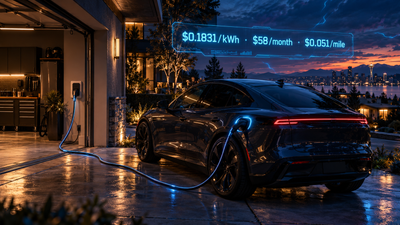
Often yes — Level 1 charging is enough when your daily driving fits inside overnight recovery. A NEMA 5-15 circuit delivers up to 1.44 kW at 12A (about 3–5 miles of range per hour on modern EVs), so 10–12 hours plugged in adds roughly 30–60 miles of range per day. If your typical daily driving is under that, Level 1 works. Use the calculator below to check your specific numbers; if the coverage ratio drops under 1.0, evaluate a 32A Level 2 charger on a 240V circuit instead.
The Level 1 sufficiency calculator
Estimates only. Assumes 87% AC-to-DC charging efficiency. Actual results vary with temperature, battery state, onboard charger limits, and the specific vehicle and equipment.
How the calculator works
Every number is derived from these formulas and one efficiency assumption:
Wall power (kW) = volts × amps ÷ 1,000
Battery-side power (kW) = wall power × charging efficiency (assumed 87%)
Battery energy per session (kWh) = battery-side power × hours per session
Weekly miles replaced = battery energy per session × nights per week × vehicle efficiency (mi/kWh)
Coverage ratio = weekly miles replaced ÷ weekly miles driven
The verdict tiers:
≥125%: Likely sufficient with useful margin.
100–124%: Likely sufficient, but missed nights or cold weather may create a deficit.
85–99%: Marginal. Occasional public charging may be needed.
Below 85%: Level 2 may be worth evaluating.
The "longest driving day" input estimates how many nights it takes to recover from your worst single day at the same setup. A positive weekly balance can still leave you short after a long trip.
What Level 1 actually delivers
Level 1 uses a 120V outlet. The current the EVSE draws is the load-bearing variable:
A typical OEM Level 1 cordset draws 12A from a NEMA 5-15 outlet on a 15A branch circuit. That is 1.44 kW at the wall, roughly 1.25 kW to the battery after losses.
A properly installed 120V / 20A setup (NEMA 5-20 receptacle, 20A branch circuit, EVSE that supports 16A) can supply 1.92 kW at the wall, roughly 1.67 kW to the battery after losses.
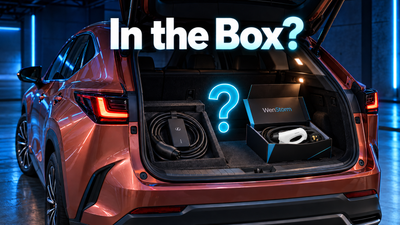
Most EVs can charge from a 120V outlet with an appropriate portable cordset, but the cordset may not be included with the vehicle. Some manufacturers include one, some sell it separately, and equipment varies by model.
The U.S. Department of Energy characterizes Level 1 as adding roughly 2–5 miles of range per charging hour, depending on the vehicle. Enter your own vehicle efficiency into the calculator for a per-vehicle number. (DOE AFDC home-charging guidance.)
Circuit and outlet safety — before you rely on Level 1
Level 1 works only when the outlet and the circuit behind it are approved for continuous EV load. Before overnight charging:
Do not use an ordinary household extension cord. Follow the EVSE and vehicle manufacturer's instructions. Use additional cord equipment only when the exact configuration is expressly approved by the manufacturer.
Do not share the outlet with other significant loads (freezer, fridge, space heater, shop tools). NEC Article 625 treats EV charging as a continuous load; shared circuits are outside that design.
If the outlet is discolored, feels unusually warm during charging, or emits an odor, stop charging and have a licensed electrician evaluate it before continuing.
Do not manually select a lower current setting (8A on some EVSEs) as a workaround for an unknown shared circuit. Lowering current does not make an unverified circuit suitable. Use manual current reduction only where the EVSE permits and after confirming the circuit can support the continuous load.
When Level 2 is worth evaluating
If the calculator returns "Level 2 may be worth evaluating," the next question is whether a Level 2 install actually works for your situation. Level 2 in most cases means:
A suitable 240V outlet (typically NEMA 14-50) already in place, OR a licensed electrician's install of one.
A dedicated branch circuit sized to the EVSE per NEC Article 625. A 32A portable EVSE requires a suitable NEMA 14-50 outlet and branch circuit that meet the product instructions. Have the outlet and circuit verified if their rating, wiring, condition, or installation history is uncertain.
Landlord approval if you rent.
Panel capacity to accept the added load. A qualified electrician's NEC Article 220 load calculation is the first step, not a service-upgrade quote.
Tesla's current US Mobile Connector bundle includes NEMA 5-15 and NEMA 14-50 adapters. Charging speed varies by model. Tesla lists a maximum 32A output for the Mobile Connector with the 14-50 adapter. See Tesla's Mobile Connector documentation for the current supported adapter list and vehicle-specific charging rates.
FAQ
What's the actual power a Level 1 outlet delivers?
Wall power = volts × amps ÷ 1,000. A NEMA 5-15 at 12A delivers 1.44 kW; a NEMA 5-20 at 16A delivers 1.92 kW. Battery-side is roughly 87% of that after AC-to-DC conversion and cable losses.
Can I use a household extension cord to reach my car?
No. Household extension cords are not designed for continuous EV charging loads. Follow the EVSE and vehicle manufacturer's instructions; use additional cord equipment only when the exact configuration is expressly approved.
Does cold weather cut Level 1 output?
Cold weather primarily changes vehicle efficiency, cabin-heating demand, and battery-conditioning requirements. It does not apply a single universal percentage reduction to charging power. Enter your winter vehicle efficiency into the calculator for a colder-weather number.
Should I use the 8A setting on my EVSE?
Only where the EVSE permits it and only after confirming the circuit can support the continuous load. Do not use manual current reduction as a workaround for an unknown shared circuit.
Do all EVs come with a Level 1 charger?
No. Some manufacturers include one in the box; others sell it separately; equipment varies by model and market. Check the vehicle's specification before assuming.
Is a 32A portable Level 2 safe on any NEMA 14-50 outlet?
A 32A portable EVSE requires a suitable NEMA 14-50 outlet and branch circuit that meet the product instructions. Have the outlet and circuit verified by a licensed electrician if the rating, wiring, condition, or installation history is uncertain. A modern dryer outlet is typically NEMA 14-30, not 14-50 — those are different receptacles on different circuits.
Is the federal 30C tax credit still available for a charger?
No. The federal 30C charging-equipment tax credit ended for property placed in service after June 30, 2026. Equipment installed earlier may still qualify if the property and location met the applicable requirements. See IRS Form 8911 instructions.