Chevy Bolt Home Charging: Charging Times & 32A vs 48A (2017-2023)
Chevrolet's own charging-rate estimates for the Bolt EV and Bolt EUV, plus the mandatory pre-charging recall check for affected 2017-2022 EV / 2022 EUV models.

TL;DR
For overnight home charging, a 32A J1772 charger is a practical option for many 2017-2023 Chevy Bolt EV and 2022-2023 Bolt EUV owners. Whether you need faster charging depends on your model year, daily mileage, and available charging time. Chevrolet's 2022 Bolt EV owner's manual (page 200) estimates about 26 miles of range per hour at 32A, versus 39 miles per hour at 48A. Check your vehicle's recall status and home electrical setup before choosing equipment.
The Bolt received a significant onboard-charger upgrade for the 2022 model year — the difference between a pre-2022 Bolt EV and a 2022 or 2023 Bolt changes what home-charging equipment gets you the fastest depleted-to-full charge time. The rest of this article walks through the decision by model year, outlet type, and daily driving distance.
Level 1 or Level 2? A Bolt Owner's Decision Framework
Chevrolet documents Level 2 (240V) as the Bolt's home-charging setup, but that assumes a 240V outlet is available and installing one is worth the cost. For many Bolt owners — especially renters, apartment residents, and short-commute drivers — Level 1 (120V) covers real-world daily driving without the electrician bill.
| Level 1 (120V) | Level 2 (240V) | |
|---|---|---|
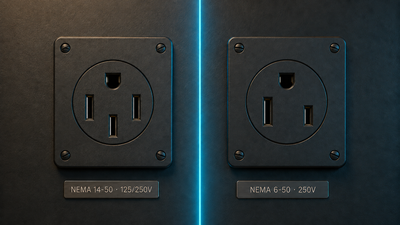
| Outlet | Any standard household outlet (NEMA 5-15) | Dedicated 240V outlet (NEMA 14-50, 6-50, or hardwired) |
| Setup | Plug and play — no electrician, no permit, no landlord conversation | Electrician install if the outlet doesn't already exist |
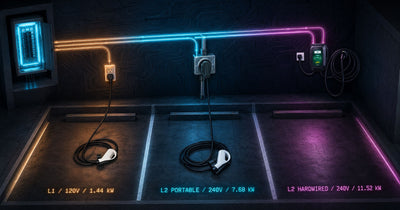
| Charging speed | ~4 miles of range per charging hour | ~26 mi/hr at 32A · ~39 mi/hr at 48A hardwired (2022+ only) |
| Overnight (8 hr) | ~30–40 miles added | Full recharge on most Bolt battery states |
| Portable EVSE cost | $169.99 | $219.99+ (portable 32A); higher for hardwired 48A |
Choose Level 1 if:
- Your daily commute is under ~30 miles
- You rent, park at an apartment, or otherwise don't have a 240V outlet
- You want the lowest-commitment entry point (no permit, no electrician, no landlord conversation)
- You park overnight for 8+ hours
Choose Level 2 if:
- Your daily commute exceeds ~40 miles
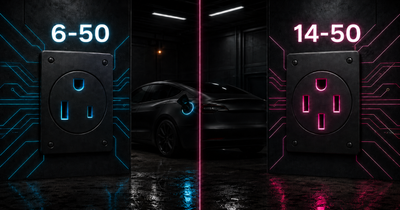
- You already have (or plan to install) a compliant NEMA 14-50 outlet
- You own the property and drive a 2022–2023 Bolt (a 48A hardwired EVSE unlocks the vehicle's full ~39 mi/hr charging rate)
- You need to fully recharge overnight regardless of starting state
If Level 1 fits your setup, the WenStorm Level 1 Portable EV Charger below is the direct product handoff. If Level 2 is the right call for your Bolt, keep reading — the model-year-specific Level 2 recommendation is documented below.

Direct answer: For a 2017-2021 Bolt EV, Chevrolet documents 240V / 32A Level 2 charging as the vehicle's home-charging setup. A 32A portable Level 2 EVSE on a NEMA 14-50 outlet matches this. For a 2022-2023 Bolt EV or Bolt EUV, the onboard charger accepts up to 48A on 240V AC. A 32A EVSE delivers approximately 26 miles of range per charging hour on any covered Bolt; a 48A hardwired EVSE (2022-2023 only) delivers approximately 39 miles per hour and reduces depleted-to-full charging from about 10 hours to about 7. All figures are approximate and depend on driving conditions, battery temperature, and cabin conditioning.
Quick Reference: Bolt Home Charging Rates (Chevrolet Documentation)
| Setup | Applicable models | Chevrolet estimate |
|---|---|---|
| 120V, 12A (Level 1 on 15A circuit) | All 2017-2023 Bolt EV and 2022-2023 Bolt EUV | ~4 miles of range per hour; approximately 55 hours from depleted to full |
| 240V, 32A (Level 2) | All 2017-2023 Bolt EV and 2022-2023 Bolt EUV | ~26 miles of range per hour; approximately 10 hours from depleted to full |
| 240V, 48A (Level 2, hardwired) | 2022-2023 Bolt EV and Bolt EUV only | ~39 miles of range per hour; approximately 7 hours from depleted to full |
Verified against Chevrolet's 2021 Bolt EV owner's manual, 2022 Bolt EV owner's manual, and 2023 Bolt EUV specifications release. These are Chevrolet's own published estimates and are more accurate than derived kW-times-hours math because they account for the vehicle's actual charging behavior, including state-of-charge tapering as the battery approaches full.
All 2017-2023 Bolt EV and 2022-2023 Bolt EUV vehicles have a J1772 AC inlet. Some earlier Bolt EVs were sold without the optional CCS DC fast-charging capability, so not every Bolt has the CCS1 DC pins even though every Bolt has the J1772 AC inlet.
How Long Does It Take to Replace My Daily Driving?
Most Bolt owners aren't trying to recharge an empty battery every night — they're topping up whatever they drove that day. The table below turns Chevrolet's rate estimates into daily-driving refill times for the 2022 Bolt EV, so the 32A-versus-48A choice is grounded in real usage rather than depleted-to-full math.
| Daily driving to replace | 120V / 12A (Level 1) | 240V / 32A (Level 2) | 240V / 48A (Level 2, hardwired — 2022+ only) |
|---|---|---|---|
| 30 miles | 7.5 hours | 1.2 hours | 0.8 hours |
| 60 miles | 15 hours | 2.3 hours | 1.5 hours |
| 100 miles | 25 hours | 3.8 hours | 2.6 hours |
Calculated estimates: daily miles ÷ Chevrolet's estimated miles added per hour (4 mi/hr at 120V / 12A; 26 mi/hr at 240V / 32A; 39 mi/hr at 240V / 48A). Not measured charging sessions — real-world results vary with weather, driving efficiency, and battery temperature. Chevrolet’s underlying estimates: 2022 Bolt EV owner’s manual, page 200.

The 2022 Redesign Changed the Onboard Charger
The 2022 Bolt EV was Chevrolet's mid-cycle redesign, and it launched alongside the new Bolt EUV crossover. Both got an onboard-charger upgrade that raised the vehicle's maximum home-charging AC acceptance rate. Chevrolet documentation for the pre-2022 Bolt EV specifies 240V / 32A Level 2 charging; Chevrolet documentation for the 2022-2023 Bolt EV and Bolt EUV specifies 240V / 48A Level 2 charging as the maximum home-charging setup.
Practical implication:
- 2017-2021 Bolt EV owners: Chevrolet documents your vehicle's home-charging setup as 240V / 32A. A 32A portable Level 2 EVSE on a NEMA 14-50 outlet matches this specification. An EVSE rated above 32A does not deliver a higher rate to your vehicle; the vehicle's onboard charger is the limit.
- 2022-2023 Bolt EV / Bolt EUV owners: Chevrolet documents 240V / 48A as your vehicle’s maximum home-charging setup. Two ratings need to line up here — the circuit and the continuous charging current. NEC's continuous-load rule pairs continuous current with at least 1.25× the circuit rating: 32A continuous charging needs at least a 40A circuit; 48A continuous charging needs at least a 60A circuit. Cord-connected (plug-in) EVSEs are additionally capped at 40A continuous under NEC 625.42, which is why the common NEMA 14-50 plug-in setup tops out around a 32A EVSE on a 40A-continuous / 50A-branch install. To actually charge at 48A, you generally need a hardwired EVSE on a dedicated 60A branch.
Home Circuit and EVSE Options by Bolt Model Year
Option 1: Level 1 on a dedicated 120V circuit (all 2017-2023 Bolt EV and 2022-2023 Bolt EUV)
A NEMA 5-15 outlet on a dedicated 120V branch circuit delivers approximately 4 miles of range per charging hour per Chevrolet's own estimates. For a driver whose typical daily driving is under 30 miles, Level 1 charging overnight (8-12 hours) can be sufficient. DOE's home-charging guidance recommends confirming any Level 1 circuit's suitability with a licensed electrician before nightly use. Level 1 is the slowest option but requires no new electrical work if a suitable existing 120V outlet is available on a dedicated circuit.
Option 2: NEMA 14-50 plug-in Level 2 with a 32A portable EVSE (all covered Bolt years)
A NEMA 14-50 outlet on a dedicated 50A branch circuit permits up to 40A of continuous EV charging under NEC 625.42, but a typical plug-in EVSE like the WenStorm delivers 32A continuous — the EVSE, not the circuit, is the ceiling in that setup. Per Chevrolet’s documentation, 32A continuous delivers approximately 26 miles of range per hour on any covered Bolt and provides approximately 10 hours depleted-to-full for 2017-2023 Bolt EV / 2022-2023 Bolt EUV.
The vehicle stops charging when the battery reaches its state-of-charge target (typically 100%, or a lower limit if you set one). A 2017-2023 Bolt EV has a rated range around 238-259 miles depending on model year; a Bolt EUV is around 247 miles rated. Once the battery is full, the session ends regardless of how much time remains in your overnight window.
No new charger installation may be needed if the property already has a compatible, correctly wired, and inspected NEMA 14-50 receptacle on a dedicated 50A branch circuit. A new receptacle or a new dedicated circuit typically requires a licensed electrician per locally adopted code.
Option 3: 48A hardwired Level 2 on a dedicated 60A circuit (2022-2023 Bolt EV / Bolt EUV only)
For 2022-2023 Bolt owners who want the vehicle's full documented AC acceptance rate, a 48A hardwired Level 2 EVSE on a dedicated 60A branch circuit is the setup. Per Chevrolet's estimate, this delivers approximately 39 miles of range per hour and reduces depleted-to-full charging from about 10 hours to about 7 hours.
The 48A hardwired option is most useful for:
- Drivers who need short charging windows (a same-day depleted-to-full turnaround)
- Drivers whose parking window is under 8 hours nightly
- Households planning to add a future EV with higher AC acceptance rates
For a pre-2022 Bolt EV owner, a 48A hardwired setup is over-provisioned; the vehicle still caps at 32A per Chevrolet's documentation regardless of what the EVSE can deliver. If you plan to keep the pre-2022 Bolt and are not planning to upgrade to a Bolt 2022+ or another EV that accepts 48A soon, a 32A NEMA 14-50 plug-in setup is a better cost-benefit match than a hardwired 48A install. That said, a 48A installation provides additional charging capacity for a future EV if your household plans include one.
Which Portable EVSE Fits a Bolt?
Any Level 1 or Level 2 EVSE with a J1772 vehicle-end connector fits any 2017-2023 Bolt EV or 2022-2023 Bolt EUV without an adapter. If you have a NACS-native EVSE (a Tesla Wall Connector or similar) and want to charge a Bolt with it, you need a compatible AC NACS-to-J1772 adapter appropriate for that specific EVSE and rated for the current involved. This does not enable DC Supercharging; Superchargers use a different electrical protocol than home AC charging.
Do not use a fixed 32A portable EVSE (such as the WenStorm 32A charger with fixed NEMA 14-50 plug) on any circuit rated below 40A continuous. That includes 30A dryer outlets (NEMA 14-30 or 10-30), which are rated for a 24A continuous EV load only. Some EVSE manufacturers offer properly engineered adapters and automatic current limiting for smaller-circuit use, but the WenStorm 32A portable charger is not configurable in that way. For Tesla owners with a 30A dryer outlet, WenStorm sells separately-branded NEMA 14-30 and 10-30 adapters designed specifically for the Tesla Gen 2 Mobile Connector (which does have current-limiting logic that recognizes those adapters); see our dryer outlet compatibility guide for the full walkthrough.
For 2022-2023 Bolt owners who want the vehicle's full 11.5 kW / 48A rate: a hardwired 48A EVSE on a dedicated 60A circuit is the setup (WenStorm does not sell a hardwired 48A product). For 2017-2021 Bolt owners, the 32A portable delivers the vehicle's full documented rate. The 32A WenStorm portable is documented in the buy-box above.
Why Does My Bolt Charge at Only 8 Amps?
If your Bolt is drawing 8 amps on a 120V outlet instead of the 12 amps you expected, the vehicle’s portable charging cord is doing what Chevrolet documents it to do. It is not a hardware fault.
Chevrolet’s 2021 Bolt EV owner’s manual (pages 91–92) describes the portable cord as a 12A charger that can be reduced to 8A. The vehicle exposes an in-menu selection between the two current levels, and the 8A setting exists specifically for older or shared 120V circuits where drawing 12A continuously could trip a breaker or overheat wiring.
Two Bolt-specific behaviors are worth knowing:
- The setting can default back to 8A. Chevrolet documents that after a charge cord is unplugged and reconnected, or after certain other events, the charge current can revert to the lower default. Reselect 12A in the vehicle menu each session if 12A is what your circuit safely allows.
- Location-based settings. The Bolt lets you save a charging profile per location (Home, Away). If your Home profile was configured for 8A on an older circuit and you’ve since upgraded the outlet, update the saved profile explicitly — the vehicle won’t upgrade it for you.
Chevrolet also cautions against selecting a current that exceeds the circuit or outlet rating. A NEMA 5-15 receptacle on a 15A branch permits up to 12A continuous EV charging under NEC 625.42; a 20A branch permits up to 16A continuous. Do not raise the vehicle’s current selection beyond what the specific circuit is rated to handle continuously — confirm with a licensed electrician if you’re unsure of the branch rating.
Related Reading
- Can You Charge an EV From a Dryer Outlet? — 14-30 and 10-30 compatibility (a fixed 32A EVSE like the WenStorm is not compatible)
- Why Is My EV Charging Slowly? — full diagnostic on what actually caps the delivered rate (vehicle OBC vs EVSE vs circuit vs supply voltage)
- Why Did My EV Charger Stop Charging Mid-Session? — the symptom-organized diagnostic if a session ends before completion
- Why Does My EV Charger Keep Tripping the Breaker? — the panel-breaker-trip diagnostic
- Why NEMA 14-50 Outlets Melt with EV Chargers — the receptacle-thermal failure mode and how to avoid it
Owners of the redesigned 2027 Chevrolet Bolt have a different charging architecture (native NACS inlet) and different setup considerations. Do not project the 2017-2023 specifications above forward. See Chevrolet's current Bolt product page for the 2027 model.
Frequently Asked Questions
How many amps does a Chevy Bolt charge at?
Chevrolet documents 240V / 32A as the Level 2 home-charging setup for 2017-2021 Bolt EV models. For 2022-2023 Bolt EV and Bolt EUV models, Chevrolet documents 240V / 48A as the maximum home-charging setup. If your home EVSE delivers less than the vehicle's documented maximum, the EVSE is the limit; if the EVSE delivers more, the vehicle caps at its own maximum.
Is my Bolt affected by the battery recall?
Check the vehicle's recall status by VIN through Chevrolet's owner recall lookup. The recall affects certain 2017-2022 Bolt EV and 2022 Bolt EUV vehicles. Follow the instructions Chevrolet provides for your specific vehicle. Vehicles with unresolved recall work or ongoing diagnostic monitoring may have specific charging limits or additional parking/charging precautions; do not follow generic overnight-charging advice without confirming your vehicle's recall status first. Sources: GM Bolt recall information, NHTSA recall bulletin.
Can I use a Tesla charger on a Chevy Bolt?
Not directly. A Tesla home charger has a NACS/J3400 vehicle-end connector, and a Bolt has a J1772 inlet. A compatible AC NACS-to-J1772 adapter appropriate for that specific EVSE and rated for the current involved can bridge the two for home AC charging. This does not enable DC Supercharging (Superchargers use a different electrical protocol than home AC charging).
Is a 32A charger enough for a 2022-2023 Bolt with 48A capability?
Per Chevrolet's own documentation, a 32A EVSE delivers approximately 26 miles of range per charging hour on a covered Bolt and provides approximately 10 hours depleted-to-full. For most drivers whose typical daily mileage is under 100 miles and whose overnight parking window is 8-10 hours or longer, 32A is more than enough. A 48A hardwired setup is most useful for short charging windows, near-empty turnaround, or households planning a future EV with higher AC acceptance rates.
What outlet do I need for a home Level 2 charger for my Bolt?
A NEMA 14-50 outlet on a dedicated 50A branch circuit is the most common Level 2 setup for a plug-in portable charger. For 2022-2023 Bolt owners who want the vehicle's full 48A rate, a 48A hardwired EVSE on a dedicated 60A circuit is required. Either installation typically requires a licensed electrician per locally adopted code.
Can I charge a Bolt from a dryer outlet (NEMA 14-30)?
Physically, a 30A dryer circuit permits up to 24A continuous EV charging. Whether your specific EVSE can be used with a 14-30 dryer outlet depends on whether the EVSE has current-limiting logic that recognizes the smaller-circuit adapter. Some portable EVSEs (Tesla's Gen 2 Mobile Connector with a manufacturer-approved 14-30 adapter, for example) recognize the adapter and limit their current draw to 24A. Others cannot fit a 14-30 or do not have an approved adapter for it. The WenStorm 32A portable charger has a fixed NEMA 14-50 plug and is not configurable for 30A circuit use; do not use it with a 14-30 dryer outlet. See our dryer outlet compatibility guide for the full walkthrough.
Do I need a different charger for a 2027 Bolt?
The 2027 Chevrolet Bolt is a redesigned vehicle with a different charging architecture (native NACS inlet). Do not project the 2017-2023 specifications in this article forward. Consult Chevrolet's current documentation for the 2027 model year, and consider a NACS-variant EVSE (or a J1772-variant EVSE with a compatible NACS adapter if applicable) rather than a J1772-variant EVSE for a 2027 Bolt.
Summary
For a 2017-2021 Chevrolet Bolt EV, a 32A portable Level 2 charger on a NEMA 14-50 outlet matches Chevrolet's documented home-charging setup and delivers approximately 26 miles of range per hour per Chevrolet's estimate. For a 2022-2023 Bolt EV or Bolt EUV, the same 32A portable delivers the same ~26 mi/hr rate; a 48A hardwired EVSE on a 60A circuit delivers approximately 39 mi/hr and shortens depleted-to-full charging from about 10 hours to about 7. All Bolt years covered use J1772, so any J1772-native EVSE fits directly. Before following any overnight-charging advice, confirm your specific vehicle's battery-recall status via Chevrolet's owner recall lookup and follow the instructions Chevrolet provides for your specific vehicle.
Disclosure
WenStorm publishes this article and sells the WenStorm Level 2 Portable EV Charger referenced in the buy-box above. Product-page URLs are direct links to WenStorm's store. Chevrolet, Tesla, and other referenced brands are not affiliated with WenStorm and their trademarks are used descriptively.
Sources
- 2021 Chevrolet Bolt EV owner's manual — authoritative for 240V / 32A Level 2 home-charging documentation for pre-2022 Bolt EV.
- 2022 Chevrolet Bolt EV owner's manual — authoritative for 240V / 48A Level 2 home-charging documentation for 2022 Bolt EV.
- 2023 Chevrolet Bolt EUV specifications — authoritative for 2023 Bolt EUV charging rates and depleted-to-full estimates.
- GM Bolt EV recall information — current recall status lookup and Chevrolet's instructions for affected vehicles.
- NHTSA recall bulletin (21V-650) — official recall bulletin for the affected Bolt EV / Bolt EUV vehicles.
- Your Chevrolet Bolt owner's manual for the specific model year — authoritative for the vehicle's onboard-charger rating, AC acceptance ceiling, and any charging-related settings and precautions.
- NEC 210.19(A)(1) and 210.20(A) — Continuous-load sizing (125% of continuous load; 80% ceiling as the mathematical result). National Electrical Code, current edition; consult your local Authority Having Jurisdiction for the adopted edition.
- NEC Article 625 — EV charging system installation provisions, including 625.40 individual-branch-circuit requirement for EVSE above 16A or 120V and 625.42 continuous-load classification for EV charging.
- U.S. Department of Energy, Alternative Fuels Data Center — Electricity for EV Charging at Home.
- Chevrolet's current Bolt EV product page — authoritative for 2027 Bolt architecture and specifications (different from the 2017-2023 vehicles covered in this article).
- WenStorm — Level 2 Portable EV Charger product page (J1772 variant for Bolt owners; NACS variant for Tesla and other NACS-native vehicles).
Real questions from EV owners
Join the Home Charging & NEMA Outlets discussion →