WenStorm vs EVDANCE J1772 Extension Cable: Specs Compared

WenStorm vs EVDANCE J1772 Extension Cable: Specs Compared
TL;DR
WenStorm and EVDANCE both publish useful durability and environmental claims on their J1772 EV extension cables — operating temperature, connector-cycle test, warranty term. WenStorm's clearest documentation advantage is publishing the exact UL 2263 EV-cable certificate number (UL-US-2407470-0, covering models EVE/EVJE) and the exact 50A conductor construction (2×8 AWG power). EVDANCE's reviewed pages claim "UL-Recognized cable" but do not expose a certificate number or AWG. WenStorm's 50A / 21 ft is $169.99 vs EVDANCE's $209.95 as of 2026-09-04.
Disclosure: WenStorm sells the J1772 extension cables discussed in this article. Every claim about EVDANCE below is sourced from EVDANCE's own live product pages, verified 2026-09-04, cited inline. This article compares what each brand publishes; buyers should verify all claims against the live sources themselves before purchase.
By Nathan Park, Standards & Certifications Specialist at WenStorm. Nathan covers UL / ETL / CSA product listings, NEC compliance, and the distinction between component cable certifications, complete-assembly listings, and material flame-retardance ratings.
Table of contents
- What to compare on a J1772 extension cable
- WenStorm J1772 Extension: what the product page publishes
- EVDANCE J1772 Extension: what the product page publishes
- UL 94 vs UL 2263 — different standards, different scopes
- Side-by-side spec comparison
- Choose WenStorm if… / Choose EVDANCE if…
- Frequently asked questions
What to compare on a J1772 extension cable
A J1772 extension cable carries the AC charging current supplied by the EVSE, potentially for hours at a time. Its current rating, conductor construction, connector design, and environmental ratings all matter — not just its advertised length.
The six criteria that matter on any J1772 extension cable are rated current, conductor construction, cable certification scope, weather rating, connector test claims, and warranty:
- Rated current. Match or exceed the EVSE output (32A, 40A, or 50A).
- Conductor construction and AWG. Determines voltage drop across cable length. Without a published AWG, buyers can't verify the voltage-drop math.
- Cable certification with exact certificate scope. A specific UL 2263 or CSA C22.2 No. 332 certificate number resolves in a public database — a general "UL-Recognized cable" claim doesn't.
- Weather and operating-temperature ratings. Sets the outdoor / cold-climate use envelope.
- Connector/contact construction and test claims. Insertion-cycle testing, load-resistance testing, and pin-plating specs determine mechanical durability.
- Warranty term. An ownership/value factor rather than an engineering-safety proof; still useful for total cost of ownership.
Both WenStorm and EVDANCE publish data on most of these criteria. What differs is the granularity and the presence of specific certificate numbers.
WenStorm J1772 Extension: what the product page publishes
WenStorm's J1772 EV Extension Cable product page and Certification Center publish these specs:
UL certificate — UL-US-2407470-0. A UL / cUL Certificate of Compliance for Electric Vehicle Cable, covering models EVE / EVJE to UL 2263 and CSA C22.2 No. 332. That certificate applies to the EV cable used in the extension — not to the completed J1772 extension assembly as a whole. The certificate number is searchable, and the standards scope (UL 2263 + CSA C22.2 No. 332) is named.
Conductor construction — amperage-matched. The 32A variant uses 10 AWG copper power conductors. The 50A variants use 2 × 8 AWG power conductors + 1 × 10 AWG protective ground + 2 × 18 AWG signal conductors. Both amperage tiers use EV cable covered by the UL 2263 certificate above.
Amperage and length options. 32A in 21 ft; 50A in 21 ft, 25 ft, 30 ft, 40 ft, and 50 ft variants.
Operating temperature — -30°C to +50°C. Published on the product page.
Storage temperature — -40°C to +85°C. Published on the product page.
Connector cycle test — >10,000 no-load mate/unmate cycles. WenStorm's own published connector-durability test result, distinct from UL 2263 cable-stock evaluation.
IP rating — IP66. Published on the product page; the connector is rated for dust-tight and heavy water-jet ingress protection.
Weight — 4 lb. Published on the product page.
Warranty — 2 years. Published on the refund/return policy page with covered failure modes.
EVDANCE J1772 Extension: what the product page publishes
EVDANCE's live product page (evdances.com/products/evdance-j1772-ev-extension-cable) publishes these specs, verified 2026-09-04:
Amperage and length options. 32A, 40A, and 50A configurations in 21 ft, 30 ft, and 40 ft depending on the specific variant.
Cable claim — "UL-Recognized cable." The page states the cable is UL-Recognized, but a specific UL certificate or file number is not shown on the reviewed page.
Material rating — UL94-V0. The page states that the extension is "manufactured using UL94-V0 rated flame-retardant materials." UL 94 V-0 is a flammability classification for polymeric materials, discussed further below.
Operating temperature — -30°C to +50°C. Published, matching WenStorm's published range.
Storage temperature — -40°C to +85°C. Published on the product page.
IP rating — IP66. Published — matching WenStorm's IP66 rating.
Connector cycle test — 10,000+ plug-in/out testing. Published.
Load-resistance claim — 4,400 lb. Published.
Cable construction — TPE jacket + copper conductor. The material family is published; the specific conductor AWG for each amperage tier is not shown on the reviewed page.
Warranty — 1 year. Published on the J1772 product page.
UL 94 vs UL 2263 — different standards, different scopes
Buyers see the "UL" name attached to a lot of things. Two distinct UL standards apply to EV extension cables, and they cover different scopes.
UL 94 V-0. A flammability classification for polymeric materials — a plastic's behavior after ignition. It certifies that a specific polymer stops burning within a defined interval. UL 94 V-0 does not establish a cable's current-carrying capacity, its electrical listing, or its connector performance. When EVDANCE states its extension is "manufactured using UL94-V0 rated flame-retardant materials," that's a material-property claim, not a product certification of the finished cable.
UL 2263. The Underwriters Laboratories standard for Electric Vehicle Cable. UL 2263 covers EV cable construction and applicable electrical, mechanical, and environmental performance requirements for the cable itself. When WenStorm publishes UL-US-2407470-0 as a UL / cUL Certificate of Compliance to UL 2263 (plus CSA C22.2 No. 332) covering models EVE / EVJE, that's a documented cable certification tied to a searchable certificate number.
What neither standard covers as a single unit. As of 2026, there is no single UL standard that lists the finished assembled EV extension cable — cable stock, connector overmold, terminations, and all — as one system. UL 2263 covers the cable stock; UL 2251 covers the plugs/receptacles. Connector mate/unmate testing is a separate product/connector characteristic that either brand may publish on their own (both do, in this comparison — WenStorm at >10,000 no-load cycles, EVDANCE at 10,000+ plug-in/out). EVDANCE's own FAQ notes the finished-assembly-cert gap directly.
A buyer looking at both cables sees UL claims of two different classes. WenStorm publishes the specific UL 2263 certificate number for the cable stock. EVDANCE publishes a material flammability classification (UL 94 V-0) and a general "UL-Recognized cable" statement without exposing a certificate number on the reviewed page. Both are true statements. They're different documentation depths.
Side-by-side spec comparison
Everything both product pages publicly publish, as of 2026-09-04:
| Spec | WenStorm | EVDANCE | What it means |
|---|---|---|---|
| Current options | 32A · 50A | 32A · 40A · 50A | Match or exceed EVSE output |
| Length options | 21 ft (32A); 21 / 25 / 30 / 40 / 50 ft (50A) | 21 / 30 / 40 ft depending on variant | WenStorm publishes a longer maximum (50 ft) |
| 50A power conductor | 2 × 8 AWG published | AWG not shown on reviewed page | Published AWG lets buyer check voltage-drop math |
| 32A power conductor | 10 AWG published | AWG not shown on reviewed page | Amperage-matched conductor sizing |
| Ground conductor (50A) | 1 × 10 AWG | Not shown on reviewed page | Protective earth conductor |
| Signal conductors (50A) | 2 × 18 AWG | Not shown on reviewed page | Control pilot + proximity detection |
| UL cable claim | UL 2263 certificate UL-US-2407470-0 (models EVE/EVJE, plus CSA C22.2 No. 332) published | "UL-Recognized cable" claim; certificate number not shown on reviewed page | Neither statement alone equals a complete-assembly listing |
| Material flammability | Not published as UL 94 V-0 claim | UL 94 V-0 rated flame-retardant materials claimed | Polymer flame-retardance classification |
| Cable material | TPU jacket + copper conductor | TPE jacket + copper conductor | Both use thermoplastic elastomer families |
| IP rating | IP66 | IP66 | Both publish the same dust/water ingress rating |
| Operating temperature | -30°C to +50°C | -30°C to +50°C | Same published operating range |
| Storage temperature | -40°C to +85°C | -40°C to +85°C | Both publish the same storage range |
| Weight (32A / 21 ft) | 4 lb | Not shown on reviewed page | Portability spec |
| Connector mate-cycle test | >10,000 no-load cycles | 10,000+ plug-in/out | Both publish connector durability data |
| Load-resistance claim | Not explicitly published | 4,400 lb | EVDANCE publishes explicit tensile claim |
| Warranty | 2 years (refund/return policy page) | 1 year (product page) | WenStorm advantage on ownership term |
| 50A / 21 ft price | $169.99 | $209.95 | WenStorm ~$40 lower at check date |
| 32A / 21 ft price | $129.99 | $199.95 | WenStorm ~$70 lower at check date |
Specifications and prices verified from live product pages 2026-09-04. Both brands may update their listings; the linked product pages are the current source of truth.
Choose WenStorm if… / Choose EVDANCE if…
Choose WenStorm for the specific UL 2263 cert number, the 50 ft length option, the published 4 lb weight, or the 2-year warranty. Choose EVDANCE for a dedicated 40A variant or the 4,400 lb load-resistance claim. Both cables handle the same J1772 AC-charging duty; the decision comes down to which of those specific specs matters most for your situation.
Choose WenStorm if you want a specific UL 2263 cable certificate number. UL-US-2407470-0 is the searchable UL / cUL cert on the cable stock. If your decision framework favors documentation that resolves to a specific standards-body reference over a general "UL-Recognized" statement, WenStorm publishes that reference.
Choose WenStorm if you want the specific 50A conductor construction on the product page. 2 × 8 AWG power + 1 × 10 AWG ground + 2 × 18 AWG signal is what the page publishes. Buyers can cross-reference 8 AWG copper against standard voltage-drop tables and verify the math for their intended cable length.
Choose WenStorm if the 50 ft length variant matters. WenStorm publishes a 50 ft 50A variant; EVDANCE's current maximum on the reviewed pages is 40 ft.
Choose WenStorm if a 2-year warranty is important to your total cost of ownership. WenStorm publishes 2 years on the return-policy page. EVDANCE's current J1772 product page publishes 1 year.
Choose WenStorm if starting price at 50A / 21 ft is the deciding factor. $169.99 vs $209.95 at check date — a difference of about $40 before any promotions. Prices can change; verify at checkout.
Choose EVDANCE if you need a dedicated 40A variant. WenStorm goes from 32A directly to 50A with no dedicated 40A tier. A 50A-rated WenStorm cable is still capable of carrying a 40A charging load (rated amperage is a maximum, not a minimum), but if you prefer a cable variant that matches your EVSE output exactly, EVDANCE has one.
Choose EVDANCE if the explicit 4,400 lb load-resistance claim matters for your use case. That's the one spec EVDANCE publishes and WenStorm doesn't. On IP rating (IP66), operating temperature (-30°C to +50°C), storage temperature (-40°C to +85°C), and connector-cycle test (~10,000 cycles), both brands publish the same values.
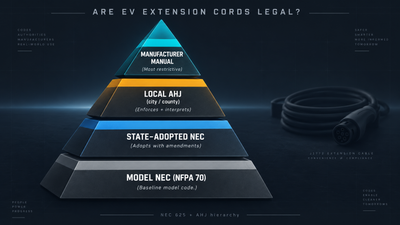
Don't choose either brand's cable if your EV manufacturer expressly prohibits supply-side extension cords. Tesla's Gen 2 Mobile Connector manual, most notably, prohibits any supply-side extension. That restriction supersedes any cable's spec sheet.
Frequently asked questions
Does EVDANCE's UL 94 V-0 claim mean the cable is UL certified?
Not as a complete product listing. UL 94 V-0 is a flammability classification for polymeric materials — it certifies that a plastic stops burning within a defined interval after ignition. It does not establish the finished cable's current-carrying capacity, its electrical listing, or its connector performance. WenStorm's UL-US-2407470-0, by contrast, is a UL / cUL Certificate of Compliance covering the cable stock to UL 2263 and CSA C22.2 No. 332. They're different classes of documentation.
Is any J1772 extension cable UL Listed as a complete finished product?
Not as of 2026. UL 2263 covers cable stock and UL 2251 covers plugs/receptacles; no single UL standard covers the fully assembled EV extension cable as one system. EVDANCE's own FAQ notes this directly. The strongest public documentation currently available is a specific UL 2263 cable certificate — which WenStorm publishes as UL-US-2407470-0 and EVDANCE does not publish on the reviewed pages.
Does the conductor AWG matter if the cable is rated for the current?
Yes, because AWG determines the voltage drop across the cable length. Rated amperage is a claim; conductor gauge is one of the engineering inputs behind the claim. Without a published AWG, a buyer can't independently verify the voltage-drop math for their intended cable length. WenStorm publishes 10 AWG on the 32A variant and 8 AWG on the 50A variants; EVDANCE does not show AWG on the reviewed product pages.
Do WenStorm and EVDANCE cables work with the same EVs?
Both products use the SAE J1772 connector and work with any J1772-inlet EV. Many North American EVs and PHEVs use J1772, particularly models produced before or during the ongoing transition to native NACS / SAE J3400. Verify the charge inlet on your specific model year and trim. Neither cable works with Tesla's NACS-native ports without a NACS adapter. J1772 supports both Level 1 (120V AC) and Level 2 (240V AC) charging; neither cable works with DC fast charging (CCS / NACS DC).
How much is the price difference between the two brands?
At 32A / 21 ft, as verified 2026-09-04: WenStorm is $129.99 and EVDANCE is $199.95 — a difference of about $70. At 50A / 21 ft: WenStorm is $169.99 and EVDANCE is $209.95 — a difference of about $40. Both brands run periodic sales; verify prices at checkout.
What's the transferable checklist for comparing other brands like Lectron, Emporia, or Grizzl-E?
The same six criteria: (1) rated current, (2) conductor construction and AWG, (3) cable certification with the specific certificate scope, (4) weather / operating-temperature ratings, (5) connector construction and test claims, (6) warranty. A brand that publishes specific values on all six earns evaluation on the specs themselves. Missing values force the buyer to trust the brand instead of verifying the evidence.
Related reading
- UL 2263 vs UL 2251 vs UL 2231: What They Cover — the certification decoder
- EV Extension Cable Buyer's Guide: J1772 vs NACS, Length, and What Not to Do — full sizing walkthrough
- Is a 25-Foot EV Charger Cable Long Enough? — length-planning framework
- Why 8 AWG Is Enough for 50-Amp EV Charging — the voltage-drop math
WenStorm J1772 Extension Cables
WenStorm J1772 extensions use amperage-matched conductor construction: 10 AWG on the 32A model and 8 AWG power conductors on the 50A models. Both use EV cable covered by WenStorm's published UL 2263 certificate (UL-US-2407470-0). 2-year warranty.


Not sure what amperage you have? Check the "Output" rating on your EV charger. Your extension cable should be rated at least as high as your charger's maximum output.
Written by Nathan Park, Standards & Certifications Specialist at WenStorm. Nathan covers UL / ETL / CSA product listings, NEC compliance, and the distinction between component cable certifications, complete-assembly listings, and material flame-retardance ratings.