Do You Need a Service Upgrade for Level 2 EV Charging?

TL;DR
Usually, Level 2 charging and a service upgrade should be evaluated as two separate decisions. First determine how much 240V charging power you actually need. Then determine whether the existing electrical service has sufficient calculated capacity for that added load under the load-calculation method accepted by your local jurisdiction. A 100A service does not automatically require an upgrade, and a 200A panel does not automatically mean unlimited charging capacity. Load-management devices, adjustable-current EVSEs, and lower-power Level 2 can, in some cases, avoid or defer a service upgrade — a strategy DOE explicitly identifies for existing residential services.
WenStorm's Framework: Two Decisions, Not One
The electrician you called quoted $4,200 for Level 2 charging — and bundled a 200-amp service upgrade into the same line item. That bundling is common, but it conflates two independent questions:
Decision 1 — How much 240V charging power do you actually need? This is a driving-pattern and vehicle-onboard-charger question, not a service-capacity question. Level 2 EV charging is fundamentally 208/240V AC and can be delivered at varying currents.
Decision 2 — Does the home's existing electrical service have sufficient calculated capacity for the additional EV charging load? This comes from the applicable service/feeder load-calculation method under the NEC edition adopted by your local authority — not from the number printed on the main breaker.
Treating them as one decision can lead to service-upgrade work being quoted before its necessity has been independently established. It can also lead some homeowners to skip a load calculation on a house where one would have flagged a real capacity constraint.
The Comparison Table
| Question | Level 2 charging decision | Service-capacity decision |
|---|---|---|
| What are you deciding? | How much charging power you need | Whether the home can support the added load |
| Key inputs | Daily miles, dwell time, vehicle AC-input limit | Existing loads, EVSE load, service rating, applicable load calculation |
| Does 240V matter? | Yes | Not by itself |
| Does breaker space decide it? | A double-pole position may be needed | No — space ≠ capacity |
| Can load management help? | Yes | Yes — may avoid or defer an upgrade |
| Does a 100A service automatically mean upgrade? | No | No |
| Who should determine it? | Driver + EVSE specs | Qualified electrical professional; AHJ requirements |
Level 2 Doesn't Mean “≥30A”
Level 2 is fundamentally 208/240V AC charging, not a specific current level. DOE's Efficient New Homes program explicitly recognizes low-power Level 2 charging at 16A/240V. Source: DOE Efficient New Homes Multifamily program (Module 1 training).
Common Level 2 delivery levels:
- 16A at 240V = about 3.8 kW
- 24A at 240V = about 5.8 kW
- 32A at 240V = about 7.7 kW
- 40A at 240V = about 9.6 kW
- 48A at 240V = about 11.5 kW
Circuit sizing follows the 125% continuous-load rule: a 32A EVSE requires a 40A circuit because the breaker must be sized to at least 125% of the EVSE's maximum continuous load. Source: DOE FEMP EV Supply Equipment Infrastructure guidance.
The practical consequence: you do not necessarily need a 40A or 50A circuit to get useful Level 2 charging. For a driver averaging 30–40 miles a day, a 16A or 24A Level 2 setup may cover overnight recovery without triggering higher-current circuit requirements.
Does a Full Electrical Panel Mean You Need a Service Upgrade?
No. Breaker space and service capacity are two different checks. A panel can be physically full while the home still has electrical capacity available under the applicable load calculation. A panel can have empty breaker spaces while the service load calculation shows limited capacity for another large load.
Two distinct checks:
- Breaker space: is there a double-pole slot free in your main panel for a new 240V circuit? This is a physical/mechanical question. A subpanel can add breaker positions without changing the service.
- Service capacity: can your service safely carry the added continuous load per the applicable calculation? This is answered by an electrical load calculation, not by counting breakers.
Bundling “full panel” and “overloaded service” into one problem — and one $4,200 quote — can result in a quote addressing both breaker-space and service-capacity issues even when only one of the two has actually been established.
What the Second Decision Actually Requires
Whether the home's existing service can accept an additional EV charging load is answered by a service/feeder load calculation under the NEC edition adopted by your local jurisdiction — not by the number printed on the main breaker.
Dwelling load calculations use nameplate loads, demand factors, noncoincident loads, and (under recent NEC editions) loads controlled by energy-management systems. Source: NFPA National Electrical Code — existing dwelling load-calculation materials; NEC §220.60 (noncoincident loads) and §220.70 (loads controlled by EMS).
For many existing dwellings, an optional existing-dwelling calculation may be available. Metered-data approaches and energy-management approaches may also be relevant depending on the installation and code edition. NFPA 70 is currently in its 2026 edition, with the 2023 edition remaining available as a prior edition — verify which edition your local authority has adopted.
The right ask, when the electrician recommends a service upgrade: ask the electrician to explain the technical basis — the applicable service/load calculation, existing equipment condition, utility requirements, or other local code requirements that make the upgrade necessary. Any of those can be a legitimate technical basis; the answer should be one of them, in writing.
Before Upgrading the Service, Check These 4 Alternatives
DOE's current strategy on residential EV integration specifically identifies managed charging and load-sharing approaches as ways to reduce or defer electrical panel/service upgrades. Four options worth evaluating before authorizing an upgrade:
1. Lower-power Level 2 — or even Level 1 — charging
16A or 24A at 240V may already replenish the driver's daily needs overnight. At 16A / 240V that is about 3.8 kW into the wall; at 24A / 240V, about 5.8 kW. Actual miles-per-hour added depends on the vehicle's efficiency, charging losses, and temperature — refer to your car's charging display for the real-time rate.
If your daily driving is light, Level 1 charging on a standard 120V outlet may cover it without any 240V circuit at all — which sidesteps the service-capacity question entirely. Before committing to a new 240V circuit or a service upgrade, check whether Level 1 overnight recovery covers your weekly miles.
🧮 Run the Level 1 Sufficiency Calculator →
2. Adjustable-current EVSE
A qualified installer may be able to configure certain listed EVSE equipment to a lower permitted current. This matters because circuit-sizing under the 125% continuous-load rule tracks the EVSE's configured maximum, not its nameplate maximum.
3. EV energy / load management
A listed power-control or energy-management system can limit EV charging based on other electrical loads on the property so that the maximum load presented to a branch circuit, feeder, or service stays within the permitted limit. Recent NEC development explicitly recognizes EMS-controlled loads and adjustable-current controls when determining the maximum load presented to a service or feeder. Sources: NEC §220.70 (loads controlled by energy-management systems); DOE Vehicle-Grid Integration Strategy (May 2025), section on avoiding or deferring residential electrical panel upgrades.
4. Existing suitable 240V circuit
If your home already has a code-compliant 240V circuit near your parking spot (dryer, welder, RV pad) and its use for EV charging is appropriate for that specific circuit and receptacle, a portable EVSE can materially reduce the electrical-installation work required — though it does not automatically address service-capacity questions.
Illustrative Scenarios (Not Load Calculations)
These are examples for framing, not verdicts. The actual answer for your home requires the applicable load calculation.
Example A — Gas-appliance house, one EV. Gas range, gas dryer, gas water heater, one Level 2 EV charger requested. A calculation may show this house has considerable headroom on a 100A service. It may not. The answer depends on what the calculation actually produces.
Example B — All-electric heat-pump home, two EVs. Heat pumps for HVAC and water heating, electric range, two EVs charging simultaneously. This profile may sit near a 100A service's calculated capacity — but load management on the EV charging can, in some cases, keep the calculation within acceptable limits without a service upgrade.
Example C — Reader with an existing 14-50 outlet. An existing NEMA 14-50 receptacle on a properly sized dedicated circuit may support portable EVSE use without new branch-circuit work. The WenStorm Level 2 Portable Charger is capped at 32A on 240V (~7.7 kW); a 50A circuit can be physically capable of higher currents for other listed EV equipment. A load calculation still applies to whether the home's service can accept the added continuous load.
Example D — Reader with a dryer circuit near the parking spot. A suitable 240V dryer circuit may support Level 2 charging if the charging equipment is specifically compatible with that receptacle and circuit. If the dryer and EV charging equipment need to share the circuit, use an appropriate listed load-sharing solution installed and configured as required — do not rely on informal scheduling alone.
Signals That the Load Calculation May Show a Real Upgrade Need
These are diagnostic signals — not verdicts. Each raises the likelihood that a load calculation will show limited remaining service capacity for additional EV charging:
- All-electric home with heat pumps for HVAC and water heating
- Electric range plus multiple large 240V appliances
- Home workshop with welder, air compressor, or shop tools on dedicated 240V circuits
- Two EVs charging simultaneously without a load-management system
- Planned addition (garage suite, ADU, workshop) within a few years
- Hardwired 48A (11.5 kW) EVSE requirement rather than 32A or lower
None of these signals proves that a service upgrade is required — or unnecessary. The deciding evidence is the applicable load analysis, existing equipment condition, and local utility and permitting requirements. Signals are for triage; the calculation is the answer.
What This Means for Your Next Move
When you receive an electrician's quote that bundles Level 2 charging with a service upgrade, itemize the two decisions and ask for supporting evidence on each:
- Line item: dedicated 240V EV branch circuit and EVSE installation. This is Decision 1. Confirm the EVSE current the quote assumes and whether a lower current or a load-management alternative was considered.
- Line item: main-panel replacement. Confirm whether this is a physical panel replacement (to gain breaker space or update aging equipment) or a service-capacity increase. Panel replacement alone does not necessarily raise the home's service rating.
- Line item: service-capacity increase (main breaker rating and/or utility service drop). This is Decision 2. Ask for the load calculation that supports it, under the NEC edition adopted by your local authority.
If the itemization or the technical basis isn't available in writing, a second opinion from another licensed electrician — specifically requesting the load calculation and the equipment/utility rationale — is worth the time.
Already Have a NEMA 14-50 Outlet? You May Not Need a New Charger Installation
If you already have a suitable NEMA 14-50 outlet on a properly sized circuit near your parking spot, you may not need to install a new wall-mounted EV charger or add a new EV charging circuit.
A portable Level 2 charger can plug directly into the existing 240V outlet, giving you Level 2 charging without permanently mounting an EVSE to the wall.
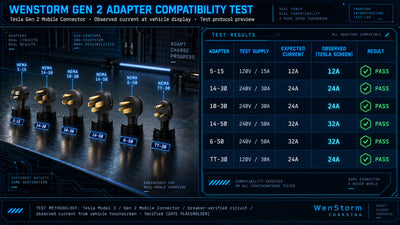
For example, the WenStorm 32A Portable Level 2 Charger plugs into a NEMA 14-50 outlet and provides up to 7.7 kW at 240V, with adjustable 16A, 24A, and 32A charging.
Before using an existing outlet for continuous EV charging, confirm that the outlet, circuit, wiring, and electrical service are suitable for the charging load. If any of those checks are uncertain, an electrician's review is the right step before continuous EV use.

Match your car and outlet with the Solution Finder if you're not sure which components fit your setup.
FAQ
Does Level 2 charging require a 200A service?
No. Level 2 charging can operate at varying currents on 208/240V AC; the applicable load calculation — not the main-breaker rating — determines whether the existing service can accept the added load. Some 100A dwellings can accept Level 2 charging without a service upgrade, particularly with lower-current EVSEs or load management. The right question is what the calculation shows, not what the main breaker reads.
Can I add Level 2 charging to a 100A house?
Often yes. The deciding evidence is a service/feeder load calculation under the NEC edition adopted by your local jurisdiction, not the 100A number itself. DOE's 2025 Vehicle-Grid Integration Strategy explicitly identifies load-sharing devices and home energy-management systems as ways to add EV charging to existing residential services while avoiding or deferring a service upgrade, including in demonstrations involving 100A services. Source: DOE VGI Strategy (May 2025).
Does a full breaker panel mean I need a service upgrade?
No. Breaker space and service capacity are two separate checks. A panel can be physically full while the service load calculation shows remaining capacity for additional load, and vice versa. A subpanel can add breaker positions without changing the service rating.
Can load management avoid a panel or service upgrade?
In some cases, yes. A listed load-management or energy-management system can limit EV charging when other home loads are high, effectively preventing coincident peak loads that would otherwise require higher service capacity. Recent NEC development explicitly recognizes EMS-controlled loads when determining the maximum load presented to a service.
How do I know whether EV charging requires an electrical upgrade?
Ask the electrician for the applicable service/feeder load calculation under the NEC edition adopted by your local authority. If the calculation shows the added EVSE load plus existing loads within the service's calculated capacity, an upgrade may not be required. If it shows the load exceeds capacity, evaluate lower-current EVSE options, load management, or a service increase.
About this guide. This is a decision-framework overview for evaluating Level 2 EV charging installations against a home's existing electrical service. It is not a substitute for a load calculation performed by a qualified electrical professional under the NEC edition adopted by your local authority having jurisdiction. Circuit sizing, service capacity, and load-management installations must comply with applicable codes and permitting requirements. For contested cases or specific installation questions, consult a licensed electrician in your jurisdiction.
Sources cited inline: DOE Efficient New Homes Multifamily program — low-power Level 2 definition; DOE FEMP EVSE Infrastructure guidance — 125% continuous-load circuit-sizing rule; DOE Vehicle-Grid Integration Strategy (May 2025), section on avoiding or deferring residential electrical panel upgrades — managed charging as a means to reduce or defer service upgrades; NFPA National Electrical Code (NFPA 70), 2026 edition (current) and 2023 edition (prior) — existing dwelling load-calculation methods, noncoincident load treatment (§220.60), energy-management-system load treatment (§220.70), and adjustable-current EVSE / power-control system provisions per current NEC development materials.
Last technically reviewed: September 24, 2026. Electrical codes and local requirements change periodically; verify against the NEC edition adopted by your local authority before acting.