Do You Need a Backup Portable EV Charger? 7 Situations to Consider

By Nathan Park — WenStorm
A backup portable EV charger can be worthwhile for drivers who travel, own multiple EVs, or have reliable access to compatible outlets away from their primary charger. It is not essential for every EV owner, and the right backup depends on whether you need broad 120V outlet access, a Tesla-specific adapter kit, or faster 240V NEMA 14-50 charging.
Below: what "backup" actually means when it comes to EV chargers (the answer depends on outlet type), seven situations where a backup pays off in convenience or resilience, honest cost math (it's not a guaranteed financial return), and a matrix that maps backup need to the right piece of equipment.
"Backup Charger" Isn't One Product Category
Before deciding whether to buy a backup, sort out what you're actually backing up. Different backup needs require different equipment.
240V Level 2 charging where a NEMA 14-50 is available. This is the WenStorm 32A portable's job (or a similar 240V NEMA 14-50 EVSE). It plugs into a NEMA 14-50 receptacle only — the same outlet used for electric ranges and RV hookups. It does not work with a standard 120V household outlet, a dryer outlet, a TT-30 RV outlet, or an ordinary 120V generator.
120V Level 1 charging from ordinary household outlets. This requires a separately listed Level 1 cordset appropriate for the outlet, circuit, and vehicle. Charging speed is roughly 3–5 miles per hour for a typical passenger EV. According to the US Department of Energy's Alternative Fuels Data Center:
“Many EV owners are able to meet their daily driving range requirements by charging overnight with Level 1 equipment, requiring no additional cost or installation, provided that a power outlet on a dedicated branch circuit is available near their parking location.” — US Department of Energy, Alternative Fuels Data Center
The DOE also confirms that EV charging is treated as a continuous load under the National Electrical Code, which is why circuit selection matters even at 120V.
Tesla-specific charging from RV / campground TT-30 outlets. A Tesla Gen 2 Mobile Connector plus the WenStorm TT-30 adapter handles this specific case. The WenStorm TT-30 adapter works only with a compatible Tesla Gen 2 Mobile Connector; it does not convert the WenStorm 32A NEMA 14-50 charger for TT-30 use.
Dryer-outlet charging (NEMA 14-30 or 10-30). This requires an EVSE with a manufacturer-approved adapter and automatic current-limiting to 24A (the 80% NEC continuous-load rule for a 30A circuit). The fixed WenStorm 32A NEMA 14-50 charger does not support this without such a manufacturer-approved adapter system, and passive plug-adapters that don't derate the current are unsafe on a 30A circuit.
If your backup need is broad 120V outlet access, you want a Level 1 cordset. If your backup need is faster 240V charging where a NEMA 14-50 is available, you want a Level 2 portable. Most EVs come from the factory with a Level 1 cordset — check what's already in your trunk before buying anything.
7 Situations Where a Backup Portable Level 2 Pays Off
Each of these assumes the backup is a Level 2 portable (like the WenStorm 32A) used at a compatible NEMA 14-50 receptacle. Substitute a Level 1 cordset if the outlet is 120V.
1. Your Primary Charger Fails
Wallboxes fail — contactor wear, communication modules, weather exposure, firmware issues. Warranty covers the repair or replacement, but the RMA cycle takes time. A backup Level 2 portable keeps home charging running only if a separate compatible NEMA 14-50 receptacle and adequate circuit are available. Many wallboxes are hardwired directly to a branch circuit with no receptacle at all — in that case, the backup portable doesn't work unless the electrician who installed the wallbox also left a matching plug-in circuit available.
2. You Travel to a Property with a Compatible Outlet
Airbnbs with a NEMA 14-50 in the garage, second homes with an RV hookup, friends' houses with a welding-shop 14-50. A portable in the trunk turns those specific outlets into Level 2 charging overnight. Verify with the host that the receptacle is on an adequate dedicated circuit before charging. See our Airbnb host playbook and road trip charging guide for outlet-scouting frameworks.
3. Two EVs on One Wallbox
You have one EV today and add a second one later. Two vehicles compete for the same wallbox on the same overnight window. A wallbox ecosystem with dynamic load balancing solves this cleanly if you plan for it. A second portable may help — but only when a separate suitable circuit and sufficient electrical capacity already exist. Two 32A EVSEs charging simultaneously can exceed the service capacity of many residential panels; a licensed electrician should assess whether your home supports it before adding a second charger.
4. You Move, Sell, or Rent Somewhere Else Temporarily
Hardwired wallboxes stay with the property. If you sell, move, or spend extended time at a second residence, the portable goes with you and continues to work at any property with a compatible NEMA 14-50 outlet on an adequate circuit. This is the same argument that makes portable the primary choice for renters (see our apartment EV charging guide).
5. You Want Level 2 Speed at a Second Property
Vacation homes, family properties, work-from-home destinations. If the second property has a NEMA 14-50 (or you can have one installed by a licensed electrician after confirming panel capacity), a portable in the trunk is the shared charger between your primary and secondary residences.
6. You Want Design Diversity Against Firmware or Vendor Issues
If a firmware push bricks your primary wallbox, an identical second wallbox from the same manufacturer may fail the same way. A different-category product (portable from a different vendor) provides different firmware, different failure modes, and different vendor support paths.
7. You Occasionally Loan or Share the Charger
Family members borrow your EV. Neighbors want to try charging at home before installing their own wallbox. A backup portable is easier to loan than uninstalling a wall unit. Any borrower must have a compatible outlet, an appropriate circuit, and a matching vehicle connector (J1772 or NACS) for the loan to be useful.
Which Backup Fits Which Need
Backup needs vary; match the equipment to the need.
| Your backup need | Appropriate equipment |
|---|---|
| Faster charging where a NEMA 14-50 is available | 240V Level 2 portable such as the WenStorm 32A NEMA 14-50 charger |
| Broad access to ordinary 120V outlets (any household plug) | A separately listed Level 1 cordset appropriate for the outlet, circuit, and vehicle |
| Tesla charging from an RV or campground TT-30 outlet | Tesla Gen 2 Mobile Connector plus the WenStorm TT-30 adapter |
| Charging from a dryer outlet (14-30 or 10-30) | An EVSE with a manufacturer-approved adapter and automatic current limiting to 24A. Not the fixed WenStorm 14-50 charger. |
The Honest Cost Framing
A backup charger should primarily be evaluated as a convenience and resilience purchase, not as a guaranteed financial return. It can reduce public-charging costs and reduce disruption when your primary charger is unavailable, but the break-even period depends on your driving distance, local charging prices, and how often you actually encounter compatible outlets away from home.
A worked example. A driver covering 250 miles per week at roughly 0.30 kWh per mile needs about 75 kWh over that week. Public DC fast charging at $0.35–$0.55/kWh (rates vary by network, region, and time of day) works out to roughly $26–$41 for that week. That's meaningful, but a single week of public charging does not pay off a $220 portable. Break-even depends on how many weeks in a year you actually need the backup and what your alternatives cost.
Real considerations that favor buying a backup:
- You value the convenience of not planning trips around public charger availability.
- You occasionally travel to properties with a compatible NEMA 14-50 already installed.
- You have a second EV or expect to add one within the ownership window of your primary charger.
- You want resilience against the specific case of an extended wallbox outage.
Real considerations against:
- Your daily driving is entirely within your primary wallbox's window and you rarely travel.
- Your primary charger is a Tesla Mobile Connector or similar OEM cordset that already provides broad outlet flexibility, and you don't need faster 14-50 charging on top of it.
- You don't have reliable access to compatible outlets away from home.
What to Look For in a Backup Portable
If you decide a backup Level 2 portable makes sense, the shopping priorities differ from a primary charger.
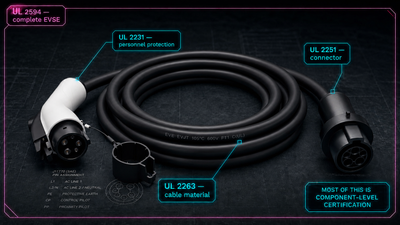
Certification is non-negotiable. Look for an EVSE listed by a nationally recognized testing laboratory (such as UL or Intertek/ETL) to applicable standards including UL 2594 and UL 2231.
Connector match matters more than amperage. A full 8-hour overnight session at 32A refills most passenger EVs (large-battery trucks and SUVs may take longer). Pick J1772 or NACS to match your car — don't overpay for amperage you won't consistently use.
Cable length matters at unfamiliar outlets. Backup charging often means outlets 20+ feet from where you park. Longer cable (25 ft is common on the higher end) is more useful than shorter cable at destinations you don't control.
Compactness matters if the charger lives in the trunk. Connector-integrated designs (no separate mid-cable control box) coil tighter and take less space than mid-cable-box designs.
App control matters less on a backup. Your primary charger probably handles scheduling and monitoring. A backup doesn't need to duplicate that.
Warranty is a data point, not the whole picture. Compare warranty coverage, exclusions, support process, and replacement availability — not only the number of years advertised. Warranty length reflects commercial policy as much as engineering, so it isn't a direct proxy for reliability.
Frequently Asked Questions
How often do wallboxes actually fail?
Individual failure rates vary by manufacturer and installation quality. Common failure modes reported in owner communities include contactor wear, weather exposure, and firmware issues. Wallbox warranties are typically 3–4 years — Emporia offers 3 years, Tesla offers 4 years on the Wall Connector for residential use — though warranty length reflects commercial policy and engineering assumptions rather than a manufacturer-published failure curve.
Can the WenStorm portable charge from a 120V household outlet?
No. The WenStorm 32A portable is a 240V Level 2 charger with a fixed NEMA 14-50 plug. It requires a 240V NEMA 14-50 receptacle on an adequate dedicated circuit. For 120V household outlets, you need a separately listed Level 1 cordset appropriate for your vehicle.
Can I use the WenStorm portable with a dryer outlet or TT-30 RV outlet?
No, not directly. The WenStorm 32A has a fixed NEMA 14-50 plug and does not derate current for lower-rated circuits. Charging from a 14-30 or 10-30 dryer outlet requires an EVSE with a manufacturer-approved adapter and automatic current-limiting. Charging from a TT-30 requires different equipment entirely — a Tesla Gen 2 Mobile Connector plus the WenStorm TT-30 adapter is the standard Tesla-specific option.
Should the backup portable have the same connector as my primary charger?
Yes. Both should match your vehicle's inlet — J1772 or NACS. Connector consistency avoids adapter chains that add complexity and potential failure points.
Does the backup need to be from the same brand as my primary?
No — and there's a case for a different brand. Design diversity means a firmware or hardware defect in one brand doesn't take out both units. If your primary is a wall-mounted Emporia Pro or ChargePoint Home Flex, a third-party portable gives you an independent codebase, supply chain, and support path.
Will a portable EV charger damage my car's onboard charger?
A properly listed, compatible, and correctly used EVSE is designed to communicate charging limits to the vehicle over the standard J1772 or NACS protocol. The primary failure mode to be aware of is on the outlet side, not the vehicle side.
Should I charge at work?
Only with explicit authorization from the property owner or facilities department, and confirmation that the receptacle and circuit are suitable for continuous EV charging. Verbal approval from a supervisor isn't sufficient — get the written approval and confirm the outlet's suitability with the person responsible for the building's electrical system.
Bottom Line
A backup portable EV charger is worth it for drivers who travel, own or plan to own multiple EVs, want resilience against wallbox failure, or have reliable access to compatible outlets away from their primary charger. It is not essential for every EV owner. Match the equipment to your actual need — a Level 2 portable for 14-50 access, a Level 1 cordset for 120V outlets, a Tesla-specific setup for TT-30 use. The wrong backup is one bought on the assumption that any charger works at any outlet.
Sources
- US Department of Energy, Alternative Fuels Data Center — Charging Electric Vehicles at Home
- Emporia Energy — NEMA 14-50 Outlet Safety: What EV Owners Need to Know
- WenStorm — Level 2 Portable EV Charger 32A NEMA 14-50 Product Page
- WenStorm — Tesla Gen 2 Mobile Connector NEMA TT-30P RV Adapter Product Page