Public EV Charging vs Gas Cost: Which Is Cheaper in 2026?
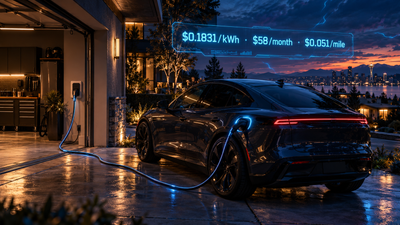
Yes if you can charge at home (EIA average $0.183/kWh). No if you rely on DC fast public charging at $0.40-0.60/kWh. Full cost math by charging mix inside.

TL;DR
-
Short answer: An EV can still be worthwhile when you rely on public charging, but it may not deliver a fuel-cost advantage. Compare the station's price per kWh, your EV's efficiency, local gasoline prices, and the MPG of the gas vehicle you would otherwise buy. Purchase price, depreciation, insurance, maintenance, and charging convenience also affect whether the EV is worth owning.
-
Home electricity (dated benchmark): The US residential average was $0.1811 per kWh year-to-date January–May 2026, per EIA Electric Power Monthly Table 5.6.B.
-
Gasoline (dated benchmark): The US retail average for regular gasoline was $4.079 per gallon for the week of August 3, 2026, per EIA Weekly Retail Gasoline Prices. Prices change weekly — use your local price for a personal calculation.
-
Break-even formula: Break-even charging price ($/kWh) = gasoline price ($/gal) × 100 ÷ MPG ÷ EV kWh-per-100-miles. Example: $4.079 × 100 ÷ 30 MPG ÷ 30 kWh/100 mi = $0.453 per kWh. Public charging below that beats gasoline for the example vehicles.
-
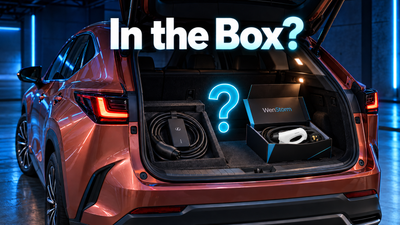
Starter setup: WenStorm Level 2 Portable Charger ($219.99, NEMA 14-50) for homes with a code-compliant 240V outlet; Level 1 Portable Charger ($169.99, NEMA 5-15) for readers whose only access is a suitable 120V receptacle.
You've seen the meme: "public DC fast charging costs the same per mile as gasoline, so what's the point of an EV?" It's a real question about EV charging cost vs gas, and it has a real answer.
The answer depends on four inputs: your local gasoline price, the MPG of the gas vehicle you'd otherwise buy, the EV's kWh-per-100-miles rating, and the price per kWh at wherever you actually charge.
This article gives you the formula, the current 2026 US benchmarks, and worked examples for four charging mixes so you can plug in your own numbers.
The short answer

Whether an EV beats gasoline on fuel cost is a per-station math question, not a universal yes/no.
Home charging almost always beats gasoline at 2026 US prices. Public DC fast charging sometimes beats gasoline and sometimes does not, depending on the station's per-kWh price and the specific vehicles being compared.
There is no universal break-even percentage — it moves with electricity rates, gasoline prices, EV efficiency, and gas-car MPG. The formula in the next section lets you compute it for your own scenario.
The break-even formula (use this instead of a rule of thumb)
The break-even charging price is the per-kWh rate at which paying for electricity costs the same per mile as paying for gasoline in the alternate gas vehicle.
Break-even charging price ($/kWh) = gasoline price ($/gal) × 100 ÷ MPG ÷ EV kWh-per-100-miles
Worked example using 2026 US benchmarks:
- Gasoline price: $4.079/gallon (EIA, week of August 3, 2026)
- Gas car MPG: 30 MPG
- EV consumption: 30 kWh/100 miles (a typical mid-size EV per FuelEconomy.gov, which reports kWh/100 mi inclusive of charging losses)
- Break-even = $4.079 × 100 ÷ 30 ÷ 30 = $0.453 per kWh
For this vehicle pair, any charging session priced below $0.453 per kWh is cheaper per mile than gasoline. Above that, gasoline wins on fuel cost alone.
Change the numbers to match your reality. A 40 MPG gas car and a 25 kWh/100 mi efficient EV yield a break-even of $0.408/kWh. A 20 MPG SUV and a 40 kWh/100 mi electric truck yield $0.510/kWh. There is no single national answer.
Home charging costs (where the math almost always works)
The US residential electricity average was $0.1811 per kWh year-to-date through May 2026, per EIA Electric Power Monthly Table 5.6.B.
For an EV rated at 30 kWh/100 miles, driving 1,000 miles requires 300 kWh from the outlet (FuelEconomy.gov's kWh/100 mi figure already includes charging losses, so no additional adjustment is needed).
At the national average of $0.1811 per kWh, that costs $54.33 per 1,000 miles.
Your utility rate matters more than the national average. Time-of-use plans in states like California can drop overnight charging near $0.10 per kWh. High-rate markets like Hawaii or the New York City area can push residential rates above $0.30 per kWh. Check your utility bill's per-kWh rate before assuming the national average applies to you.
Public Level 2 costs
Public charging does not have one national price. The following examples use $0.30 per kWh for public Level 2 as an illustrative scenario. Check the station or network app for the actual energy, session, parking, and idle fees before charging.
Pricing patterns vary by site:
- Free stations: Some shopping centers, hotels, and municipal lots offer free Level 2 charging as an amenity. Use the DOE Alternative Fuels Data Center station locator and filter to "Free" for a current map.
- Session-based pricing: Common at retail sites. Typically $1 to $2 per hour connected, or $0.20 to $0.40 per kWh dispensed.
- Subscription networks: Electrify America and EVgo publish membership plans that reduce per-kWh cost for frequent users. On ChargePoint, individual station owners set pricing, so there is no single ChargePoint driver price.
At $0.30 per kWh, 1,000 miles of driving at 30 kWh/100 mi costs about $90 — cheaper than the $135.97 gasoline baseline but 66% more than home charging.
DC fast charging costs
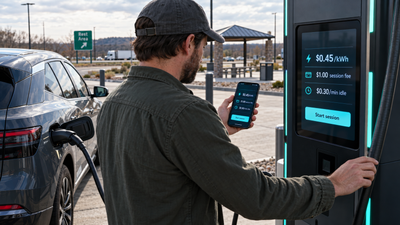
DC fast charging prices vary by station, location, time, membership status, and vehicle ownership. Publicly listed illustrative ranges as of August 2026:
- Electrify America, EVgo, and ChargePoint DC fast: commonly $0.40 to $0.60 per kWh for pay-as-you-go pricing (see the network pages linked above)
- Tesla Supercharging for Tesla owners: often lower than third-party networks, typically $0.30 to $0.45 per kWh, with substantial site-to-site and time-of-day variation
These are illustrative ranges, not national averages. Confirm the specific station's price on the network app before plugging in.
At $0.50 per kWh (the middle of the third-party range), 1,000 miles of driving costs $150. That is above the $135.97 gasoline baseline in this example — but below it if the station price is under the $0.453/kWh break-even calculated above.
DC fast is the fastest paid option. Many newer fast-charging-capable EVs can add 150 to 250 miles in 20 to 40 minutes under favorable conditions; vehicle, charger, temperature, and starting battery state all affect the result.
What each mix costs for 1,000 miles
| Energy source or mix | Cost per 1,000 miles | Vs gasoline |
|---|---|---|
| All home ($0.1811/kWh) | $54.33 | Saves $81.64 |
| 80% home / 20% DC fast | $73.46 | Saves $62.51 |
| 50% home / 50% DC fast | $102.17 | Saves $33.80 |
| All DC fast ($0.50/kWh) | $150.00 | Costs $14.03 more |
| Gasoline (30 MPG @ $4.079/gal) | $135.97 | baseline |
Under these assumptions, the break-even mix is approximately 15% home / 85% DC fast — well beyond the 50/50 rule of thumb that circulates online.
Every input matters. Higher local gasoline prices or lower DC fast rates move break-even toward more public charging. Cheaper home electricity or lower-efficiency gas cars move it toward less public charging. Compute your own.
Non-cost EV advantages
Fuel cost is one factor. EVs also have advantages that do not show up in a per-mile cost table:
- Maintenance savings. EVs eliminate engine oil changes, spark plugs, fuel filters, and exhaust-system service. Model-specific reduction-gear fluid, battery coolant, brake fluid, and tire rotations still apply. Consumer Reports and the DOE Alternative Fuels Data Center both publish EV maintenance-savings estimates; check DOE AFDC EV maintenance for the current per-mile figure.
- No gas station visits for home-charging drivers. Charging happens overnight. Zero fuel stops for daily driving.
- Instant torque. EV acceleration off the line is a driving-experience upgrade unrelated to cost.
- Cabin comfort during stops. When plugged in, preconditioning can draw energy from the grid and reduce battery energy used for cabin conditioning. No engine idling required.
- Quieter cabin at low and mid speeds. Consistent NVH improvement over gasoline drivetrains, especially in stop-and-go traffic. Highway wind and tire noise can reduce the difference at speed.
- Home fueling convenience. Never wait in a gas station line for daily driving.
None of these fully recover the cost gap for all-public DC fast drivers, but they materially improve the ownership case for home-charging drivers already ahead on fuel cost.
When gasoline may win on energy cost or charging practicality
Gasoline may be the better choice on energy cost or convenience in specific scenarios. This is not a total-cost-of-ownership conclusion — purchase price, depreciation, insurance, and maintenance still need a vehicle-to-vehicle comparison.
- You drive 100+ miles per day AND have no home charging AND have no workplace or public Level 2 within convenient reach. The all-public DC fast math is against you at typical 2026 prices.
- You live in a DC fast desert. Some rural US regions have thin DC fast station coverage. Check the DOE AFDC station locator before buying.
- Frequent sub-zero climate AND only Level 1 home access. Cold-weather range loss combined with slow Level 1 recovery can push you into paid public charging you would not otherwise need.
- Heavy towing at highway speeds daily. EV towing range loss is real and model-dependent; check your specific vehicle's towing range documentation before committing to an EV over a gas or diesel truck for commercial-scale towing patterns.
Total ownership cost is separate. Purchase price, financing, depreciation, insurance, registration, maintenance, tires, charging equipment, and time-and-convenience are all part of the real comparison. A vehicle-to-vehicle TCO calculation is the only defensible way to say gasoline "wins" or "loses" overall.
The 2026 tax-credit reality
The federal New Clean Vehicle Credit and Previously-Owned Clean Vehicle Credit are unavailable for vehicles acquired after September 30, 2025, per current IRS clean-vehicle guidance.
Do not budget for a $7,500 federal tax credit on a 2026 EV purchase. Buyers who entered a qualifying binding contract and made a payment on or before September 30, 2025 may fall under transitional rules.
The federal Alternative Fuel Vehicle Refueling Property Credit (§30C) also generally requires qualifying charging equipment to have been placed in service before July 1, 2026. State and utility EV incentives may still apply — check DOE AFDC state programs for current offers in your area.
If home charging is your answer: starter setup
The Level 2 Portable Charger may be used with a code-compliant NEMA 14-50 receptacle and circuit that meet the charger manufacturer's requirements. It supplies up to 7.7 kW; real-world range added per hour varies by vehicle efficiency, temperature, and charging losses. If the circuit or receptacle condition is unknown, have it inspected before continuous EV charging.
The Level 1 Portable Charger operates at 12A continuous on a standard 15A NEMA 5-15 branch circuit (approximately 1.4 kW input), adding roughly 2 to 5 miles per hour per DOE AFDC. Use only a properly grounded 120V receptacle and circuit in good condition. Do not use a loose, damaged, corroded, warm, or frequently tripping outlet. Have an unknown circuit evaluated by a qualified electrician.
If you have neither a 14-50 nor a suitable 120V outlet at your parking spot, see our home EV charging without installation guide for the workplace-plus-public-Level-2 path.
FAQ
How much does charging an EV from 20% to 80% cost at home?
For a 60 kWh battery, 20% to 80% is 36 kWh delivered to the battery. At the US residential average of $0.1811 per kWh, that costs about $6.52. FuelEconomy.gov's per-vehicle kWh/100 mi figure already includes charging losses, so use that figure for accurate per-mile math without adding a separate loss adjustment. Your utility rate may be lower on off-peak time-of-use plans.
Is DC fast charging always more expensive than gasoline?
No. It depends on the station's per-kWh price, your EV's efficiency, and local gasoline prices. Using the break-even formula (gasoline price × 100 ÷ MPG ÷ EV kWh-per-100-mi), any DC fast rate below the calculated break-even is cheaper than gasoline for the vehicles being compared. At $4.079/gal gasoline, 30 MPG, and 30 kWh/100 mi, break-even is $0.453/kWh. DC fast stations priced below that beat gasoline; stations above do not.
Do free public chargers still exist?
Yes. Many hotels, shopping malls, workplaces, and some municipal parking lots offer free Level 2 charging as an amenity. Use the DOE AFDC station locator and filter to "Free" for a current map of your area.
How much do EVs actually save on maintenance vs gas cars?
Several thousand dollars over a typical ownership period. Savings come from eliminated oil changes, spark plugs, exhaust service, and reduced brake wear from regenerative braking. Tire wear is comparable or slightly higher on EVs due to higher curb weight — factor that in for your specific vehicle. Consumer Reports and DOE AFDC both publish current EV maintenance-savings estimates; check DOE AFDC EV maintenance for the current per-mile figure.
What's the break-even mix between home and public charging?
There is no universal answer — it depends on your specific electricity rate, gasoline price, EV efficiency, and gas-car MPG. Under the example inputs in this article (30 kWh/100 mi EV, 30 MPG gas car, $0.1811/kWh home, $0.50/kWh DC fast, $4.079/gal gasoline), the break-even mix is approximately 15% home / 85% DC fast. Recompute with your local numbers.
Are Tesla Superchargers cheaper than other DC fast networks?
Often but not always. Tesla Supercharger pricing for Tesla owners runs roughly $0.30 to $0.45 per kWh in illustrative examples — commonly below the $0.40 to $0.60 per kWh range at Electrify America or EVgo. Non-Tesla vehicles using Superchargers via NACS access typically pay slightly more than Tesla owners. Confirm the specific site's price in the Tesla app before charging.
Ready to compute your own?
Use the break-even formula with your local gasoline price and the MPG of the gas vehicle you'd otherwise buy: break-even $/kWh = gasoline price × 100 ÷ MPG ÷ EV kWh-per-100-mi.
If home charging is viable for you: see the WenStorm Level 2 Portable Charger → ($219.99) for NEMA 14-50 outlets, or the Level 1 Portable Charger → ($169.99) for standard 120V access.
Not sure what fits: use the WenStorm Solution Finder → to see the home-charging setup that matches your outlet, vehicle, and daily driving.