What Should Come With Every Used EV? A Dealer Charging Checklist

TL;DR
- A used EV may arrive with missing, damaged, or mismatched portable charging equipment. Even when the original cord is present, the buyer may not know whether it fits the outlet available at home.
- Run the checklist twice: once at trade-in / acquisition, and once at delivery.
- Record AC (J1772 or NACS) and DC (CCS1, NACS, or CHAdeMO) compatibility separately. Home charging equipment must match the vehicle's AC inlet.
- The dealer's role is to record the buyer's reported outlet and recommend an appropriate product category — not to certify the customer's electrical system.
- Do not automatically bundle every adapter and extension cable into every delivery. Match equipment to the buyer's verified vehicle and outlet.
Short answer: A used EV may arrive with missing, damaged, or mismatched portable charging equipment. Even when the original cord is present, the buyer may not know whether it fits the outlet available at home. This checklist gives dealer teams a repeatable process to inspect the equipment, understand the buyer's charging situation, and document everything at handover.
Used EV volume in the U.S. keeps growing. Cox Automotive reported that March 2026 used-EV sales were up 27.7% year over year (Cox Automotive EV Market Monitor, March 2026). Some used-EV buyers are new to home charging, and one of their most practical questions is how and where they can charge after delivery.
That first-day charging experience is now part of the dealer's brand.
The checklist below is designed to be run twice: once at trade-in / acquisition, and once at delivery. Throughout, EVSE refers to the portable charging cord — technically electric vehicle supply equipment — that plugs the car into a wall outlet.
1. What charging equipment actually came with the trade-in?
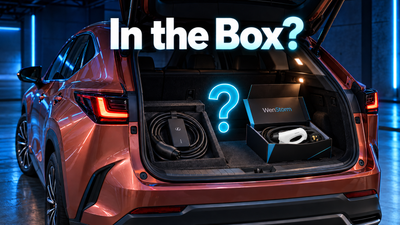
Before the car goes on the lot, verify what's in the trunk, the frunk, or the storage bag:
- Portable EVSE (mobile connector / travel charger) present?
- Original manufacturer bag or case present?
- Any plug adapters included (NEMA 5-15, 6-20, 14-50, TT-30)?
- Extension cable, storage hooks, or wall bracket present?
Document the condition on the vehicle intake sheet the same way you would a spare tire or a second key.
2. Is the included equipment damaged or recalled?
Inspect the equipment before it goes back to the customer:
- Cable jacket free of cuts, abrasions, or heat damage?
- Plug blades straight, unmelted, and free of discoloration?
- Connector housing free of cracks; latch functioning?
- No visible burn marks, moisture damage, or damaged seals?
- Equipment that passes visual inspection tested only by trained staff, using a suitable test setup and the manufacturer's instructions?
- Serial number checked against the equipment manufacturer's active recall list and the CPSC recall database?
Do not energize equipment showing visible damage. Damaged or recalled equipment should be removed from the vehicle, not passed on with the sale.
3. What charging connectors does this vehicle use?
Record AC and DC compatibility separately:
- AC charging: J1772 or NACS
- DC fast charging, if equipped: CCS1, NACS, or CHAdeMO
- Connector confirmed for this specific model year and configuration?
Home charging equipment must match the vehicle's AC inlet. DC fast-charging compatibility is a separate consideration. See the DOE Alternative Fuels Data Center's connector guide for the current AC/DC distinctions.
4. What outlet does the buyer actually have at home?
Ask before delivery — do not assume. A short intake form works:
- Standard 120V household outlet (NEMA 5-15) only?
- 240V outlet already installed in garage or driveway (NEMA 14-50, 6-20, 14-30, etc.)?
- No dedicated outlet — apartment, street parking, rental, or shared garage?
- Outlet on a dedicated circuit, or shared with other loads?
- Circuit breaker amperage and receptacle age known?
The answer determines whether Level 1 (120V) or Level 2 (240V) is realistic, and whether any additional equipment is safe to recommend.
5. Does the equipment match the outlet and the circuit?
Outlet shape alone does not establish compatibility. Confirm the following before telling a buyer a specific charger will "work" at their home:
- Voltage and amperage of the circuit match the EVSE rating
- Circuit is rated for the continuous load an EVSE will draw
- Receptacle is in good condition (no scorching, no loose blades)
- Receptacle is properly grounded
- Circuit is dedicated to the outlet where the EVSE will be plugged in
- Any adapter used is approved for that specific EVSE and outlet pairing
If any item is unknown, the buyer should verify with a licensed electrician before the first charging session. This is a safety item, not a sales item.
The dealer's role is to record the buyer's reported outlet and recommend an appropriate product category — not to certify the customer's electrical system. If the circuit, receptacle condition, or rating is uncertain, refer the buyer to a licensed electrician.
6. What optional equipment does the buyer actually need?
Only recommend what the vehicle and outlet situation calls for. A short decision guide:
| Buyer situation | Reasonable optional equipment |
|---|---|
| 120V outlet only in garage | Level 1 portable EVSE matched to the vehicle inlet |
| 240V outlet already installed and correctly rated | Level 2 portable EVSE matched to the vehicle inlet and to the outlet's NEMA configuration |
| No home outlet (apartment, rental, street parking) | Public or workplace charging plan; portable Level 1 only when the buyer has permission to use a suitable 120V outlet |
| Parking position farther from the EVSE than the vehicle cable reaches | A compatible vehicle-side extension cable, rated for the charging current and used only where permitted by the vehicle, EVSE, and cable manufacturer instructions |
| Vehicle inlet differs from the AC connector the buyer's existing home EVSE provides | Direction-specific AC connector adapter (for AC Wall Connectors, Destination Chargers, and Mobile Connectors — not for DC fast charging) |
Do not automatically put every adapter and every extension cable into every delivery. Match the equipment to the buyer's verified situation.
7. What safety and warranty information should accompany delivery?
Before the customer drives off the lot:
- Written outlet-safety checklist provided
- EVSE user manual and quick-start guide included
- Model-specific safety-listing and compliance documentation available for the buyer to review
- Warranty terms explained, including who to contact for support
- Return / exchange policy for any optional equipment sold at delivery
- Dealer contact for follow-up charging questions in the first 30 days
Model-specific safety-listing and compliance documentation is available for applicable WenStorm products. Coverage varies by model — dealers should confirm the exact model and certification scope before ordering. See the WenStorm Certification Center.
How dealers can think about the commercial side
This checklist is a delivery-quality process first. It is also, quietly, a commercial opportunity.
Dealers may choose to offer a matched portable charging kit as an optional accessory when the checklist shows the buyer will need one. The potential monthly accessory gross can be modelled as:
Monthly used-EV deliveries × offer rate × customer acceptance rate × gross profit per kit.
That model requires real inputs — offer rate, acceptance rate, and per-kit gross — which are best established by running a short pilot before designing a full accessory program. Any kit sold at delivery should be presented as an optional accessory with transparent cost, suggested retail pricing, and a clear benefit the customer can evaluate before purchase, consistent with the FTC's guidance on dealership add-ons.
WenStorm is inviting a limited number of used-EV dealers to participate in an initial 30-day pilot to measure these numbers before publishing them. If you'd like to be part of that data set, get in touch.
Where WenStorm fits
WenStorm supplies portable EV charging equipment across the categories relevant to this checklist:
- Level 1 and Level 2 portable EVSE in J1772 and NACS
- Vehicle-side EV extension cables that add reach between the EVSE and the vehicle
- AC connector adapters, including NACS-to-J1772 for compatible Tesla Wall Connectors, Destination Chargers, and Mobile Connectors (AC only — not for DC fast charging)
- NEMA plug adapters for specific EVSE models (confirm compatibility with the exact charger before ordering — most listed adapters are designed for the Tesla Gen 2 Mobile Connector rather than as universal adapters for every portable EVSE)
Model-level compatibility and certification detail is on each product page and in the Certification Center.
Next step
→ Request the Dealer Charging Checklist as a printable PDF for your service and delivery teams. A short intake form captures dealership name, contact name and email, monthly used-EV volume, Tesla vs. non-Tesla inventory mix, and number of locations. Until the form is live, email contact@wenstormcharge.com with the same information.
→ Explore the dealer charging program — model-specific pricing, sample policy, and pilot details are shared on request. Visit the current dealer inquiry page. The dedicated dealer program page is in build.
Sources
- Cox Automotive — EV Market Monitor, March 2026. coxautoinc.com/insights/ev-market-monitor-march-2026
- Federal Trade Commission — Car dealerships can't charge you for add-ons you don't want, 2024. consumer.ftc.gov
- U.S. Department of Energy Alternative Fuels Data Center — Charging Infrastructure Development. afdc.energy.gov/vehicles/electric-consumers
- U.S. Consumer Product Safety Commission — Recall database. cpsc.gov/Recalls
- WenStorm Certification Center. wenstormcharge.com/pages/certification