How Long Does It Take to Charge an Electric Car?
A full battery takes ~1 hour at a 50 kW DC fast charger, 7-10 hours at Level 2, or 30-50 hours on a standard 120V outlet. Free calculator estimates your exact charge time based on battery, charger, and onboard-charger limit.
TL;DR
Charging a typical EV from about 20% to 80% at home takes roughly 1 hour at a 50 kW DC fast charger, 6–8 hours on a 240V Level 2 (NEMA 14-50) setup, or 30–50 hours on a standard 120V outlet. Exact time depends on your usable battery size, the AC or DC power actually delivered to the car, and your onboard-charger limit. The calculator below uses those three inputs to produce an hour-and-minute estimate (not a precise prediction). Public DC fast charging only approaches advertised speeds while the battery is below ~50%, so the "80%" number is a practical ceiling, not the full 100% refill.
EV charging time calculator
Pick your charger type and battery, then override the inputs with your car's real numbers if you know them. Results are a straight energy-divided-by-power estimate with a 10% charging-loss allowance. They are not a Tesla, Ford, Chevy, Hyundai, Rivian, GM, Kia or any other manufacturer's warranty — compare to your vehicle's own charging-rate table before acting on them.
On AC chargers, the car charges at whichever is smaller — the EVSE's output or your car's onboard-charger limit. DC fast charging bypasses the onboard charger; the car itself tapers power as the battery fills.
What determines charging speed and total charging time
Three numbers set your AC charging time: usable battery capacity (kWh), the power your EVSE actually delivers (kW), and your car's onboard-charger limit (also kW). On AC, the car charges at whichever is smaller — the EVSE's output or the onboard limit. If your car's onboard-charger limit is 7.7 kW (common on compact EVs), a 48A EVSE (11.5 kW nominal) and a 32A EVSE (7.7 kW nominal) deliver the same real-world rate because the car is the bottleneck.
DC fast charging bypasses the onboard charger entirely. The vehicle itself negotiates the actual delivery rate with the station, and almost every EV tapers power as the state of charge climbs past 50-60%. Advertised peak speeds (150 kW, 250 kW, etc.) usually apply only to a narrow window below ~50% charge; beyond that, the car protects battery health by slowing down.
How long does it take to charge an EV? Typical times by charger type (~75 kWh battery)
These are rounded estimates at a 10% charging-loss allowance; your car's own charging-rate table should always win over the generic math below.
| Charger type | Typical power | 20% → 80% time | Common fit |
|---|---|---|---|
| Level 1 (120V @ 12A) | 1.4 kW | ~36 hours | Overnight top-up for PHEVs, light daily driving |
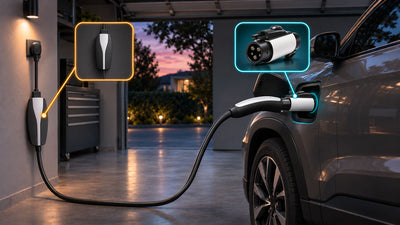
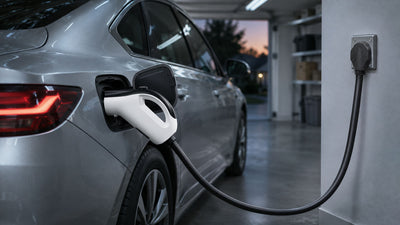
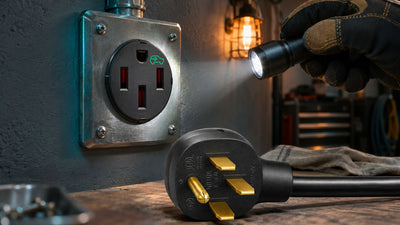
| Level 2 (240V @ 32A, NEMA 14-50) | 7.7 kW | ~6–7 hours | Mainstream home charging; portable or wall-mounted |
| Level 2 (240V @ 48A, hardwired) | 11.5 kW | ~4–5 hours | Larger-battery EVs with 11-11.5 kW onboard chargers |
| DC Fast (50 kW) | 50 kW | ~55–75 min | Older highway stations; slower tapering |
| DC Fast (150-250 kW) | peak 150-250 kW | ~18–35 min | Newer Tesla V3 Supercharger / Electrify America / EVgo |
How long to charge a Tesla, specifically?
Tesla's own published Mobile Connector charging rates land in the same range the calculator produces. A Model 3 Long Range (~75 kWh usable) going from 20% to 80% stores about 45 kWh of battery energy, which is roughly 50 kWh drawn at the outlet after a ~10% AC charging loss. At 32A on a NEMA 14-50 outlet (the standard Tesla Gen 2 Mobile Connector pairing), that's roughly 6–7 hours — matching Tesla's charging-rate guide. At a V3 Supercharger with the battery pre-conditioned, Tesla documents up to 250 kW peak and typically 15–25 minutes from 10% to 80%.
Tesla's documentation prohibits using an extension cord with the Mobile Connector, and that restriction does not change by lowering current or using heavier gauge wire. For home charging, Tesla's path is: install a NEMA 14-50 on a dedicated 50A circuit, or hardwire a Tesla Wall Connector (up to 48A).
Why the "0% to 100%" number is misleading
Public DC fast-charging advertising almost always quotes the 10–80% or 20–80% window because that's where power delivery is highest. Charging the last 20% can take as long as the first 50% because of the taper curve. For practical road-trip math, treat 80% as your top-up target; your trip-planner will do the same.
At home on AC, going to 100% is fine but not usually necessary. Most EV owner's manuals recommend keeping the daily charge at 80–90% for long battery life, charging to 100% only before trips.
Does weather change charging time?
Yes, meaningfully. Cold batteries accept power more slowly, both on AC and (more dramatically) on DC fast charging. Our dedicated winter-charging article covers the mechanisms; the practical rule is that AC Level 2 charging may take 10–25% longer in sub-freezing conditions, and DC fast charging can take 30–60% longer if the battery is cold and un-preconditioned.
Frequently asked questions
Can I charge an EV from 0% to 100% every night?
You can, but you probably shouldn't. Most owners manuals recommend keeping the daily charge window at 80–90% to preserve long-term battery capacity. Charging to 100% is fine occasionally — before a trip, for example.
Does a bigger EVSE always charge faster?
No. On AC, the car's onboard charger is the ceiling. If your car's onboard charger caps at 11 kW, a 48A (11.5 kW) EVSE and a 40A (9.6 kW) EVSE deliver nearly the same real-world rate.
How accurate are these numbers?
The calculator uses a straight energy-over-power model with a 10% loss allowance (5% on DC fast). Your actual charge time depends on battery temperature, state of health, the specific DC-charger taper curve, and ambient conditions. Use the number as a planning anchor, not a warranty.
Where can I verify the Tesla-specific figures?
Tesla publishes charging rates for the Mobile Connector and Wall Connector in its support documentation. Model-specific DC fast-charging curves are also published in the Tesla trip planner. We update the calculator defaults when Tesla's published figures change.
About this guide
This article estimates AC and DC charging times from first-principles energy math (kWh / kW × efficiency) applied to standard EV battery and EVSE specifications. The calculator is a planning tool, not a prediction of exactly what your car will do on a specific night at a specific outlet. We cross-check our defaults against Tesla's published Mobile Connector charging rates and NEC Article 625 continuous-load limits (80% of circuit rating), and we update the defaults as manufacturers revise their published figures. Last reviewed 2026-10-27.