Can I Charge My EV at Home with a J1772 Charger?

Yes — and there's a good chance the charger you're looking at already uses J1772 without you realizing it.
J1772 is the standard connector for Level 2 home charging in North America. Almost every non-Tesla EV on the road accepts it natively. Most portable home chargers output J1772 on the car side. The question isn't whether you can use J1772 at home — it's whether your home has the right outlet for the charger to plug into on the wall side.
This guide explains exactly how J1772 charging works, what your home needs to support it, and how to start charging tonight without any installation.
Yes — J1772 Is the Standard Home Charging Connector in North America
When people ask "can I use a J1772 charger at home," they're usually one of three things:
- A new EV owner who just saw the J1772 label on their charger and wants to know if it works at home
- Someone looking at a Level 2 EVSE (the charging station) and wondering if it's compatible with their EV and their home
- A Tesla owner wondering if they can use third-party J1772 charging equipment
The answer to all three: yes. J1772 is designed specifically for home and public Level 2 charging. It's not a specialty industrial connector or a commercial-only standard — it's the everyday home charging plug.
The SAE J1772 standard (maintained by SAE International) has been the default for AC Level 1 and Level 2 charging in North America since 2010. Every major EV manufacturer except Tesla (and now some Tesla models with NACS) builds their car's charging port around it.
What Is a J1772 Connector? (The Two Sides Explained)
A J1772 "charger" actually has two separate connection points — and understanding both clears up a lot of confusion.
The car side: J1772 handle
The J1772 connector is the physical handle that plugs into your car's charging port. It has 5 pins:
- L1 and L2 — the two AC power conductors (hot lines)
- Ground — safety ground
- Proximity pilot — tells the car the plug is connected
- Control pilot — communicates charge rate and status between the EVSE and the car's onboard charger
This is the standardized side. Every J1772-compatible EV accepts this same connector shape and pin layout.
The wall side: whatever outlet the charger plugs into
The other end of the charging cable — the part that connects to your home's electrical system — is not standardized. Different portable chargers and EVSEs use different outlet types:
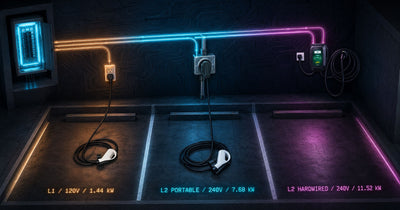
- NEMA 5-15 (standard 120V wall outlet) → Level 1 charging, 3–5 mph
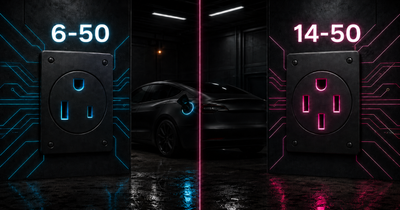
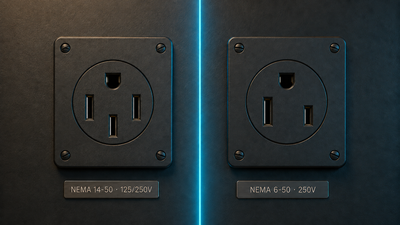
- NEMA 14-50 (240V/50A garage outlet) → Level 2 charging, 28–35 mph
- NEMA 14-30 (240V/30A dryer outlet) → Level 2 charging, 18–22 mph
- Hardwired (no plug, direct connection) → Level 2, wall units only
The J1772 connector is always the same. The outlet it needs at home depends on the charger model. WenStorm's Portable Level 2 Charger uses a NEMA 14-50 on the wall side — the same outlet found in most garages with RV hookups or workshop circuits.
Which EVs Use J1772?
All of these use J1772 natively:
- Ford (Mustang Mach-E, F-150 Lightning, Escape PHEV)
- Chevrolet (Bolt EV, Bolt EUV, Equinox EV)
- Hyundai (IONIQ 5, IONIQ 6, Kona EV)
- Kia (EV6, Niro EV)
- Rivian (R1T, R1S)
- Volkswagen (ID.4)
- BMW (i4, iX, i7)
- Nissan (Leaf, Ariya)
- Audi (e-tron, Q4 e-tron)
- Honda (Prologue)
- Virtually every non-Tesla EV sold in North America
Tesla:
Teslas use the NACS (North American Charging Standard) connector on the car side. Tesla includes a J1772 adapter with most vehicles, which allows the car to accept J1772 charging from any compatible EVSE. Tesla owners can use any J1772 charger — they just need their included adapter in-line.
New vehicles with NACS:
Some 2024–2025 Ford, GM, and Rivian models are switching to NACS ports. These vehicles can use J1772 charging with a NACS-to-J1772 adapter (available from the manufacturer or third parties).
The practical takeaway: J1772 covers essentially every EV currently in use, either natively or with a straightforward adapter.
What Does a J1772 Charger Need to Plug Into at Home?

This is the piece most guides skip — and it's where the real decision lives.
A J1772 portable charger is a two-ended device:
- Car end → J1772 connector (standardized, always the same)
- Wall end → NEMA outlet plug (varies by charger model)
To use a J1772 Level 2 charger at home, your wall needs to have the right outlet for your specific charger's plug. For the WenStorm Portable Level 2 Charger, that means a NEMA 14-50 outlet — a 4-prong, 240V outlet rated at 50 amps.
Common places to find a NEMA 14-50 in your home:
- Garage (often installed for RV hookups or heavy workshop tools)
- Utility room
- Outdoor power pedestal
If you have one of these outlets within reach of your parking spot, you have everything you need for full J1772 Level 2 charging at home — no installation required.
If you don't have a NEMA 14-50, a standard 120V wall outlet will run the charger at Level 1 speed (3–5 mph). That works for low-mileage drivers but falls short for daily commuters.
For a full walkthrough of identifying your home outlets, see our no-install home charging guide →.
Do You Need to Install Anything for J1772 Home Charging?
Not if a NEMA 14-50 (or other 240V outlet) is already accessible near your parking spot.
Most guides treat J1772 home charging as synonymous with hiring an electrician and mounting a wall unit. That assumption is wrong for the majority of homeowners. Portable J1772 chargers plug directly into existing outlets — no permits, no hardwiring, no installation visit required.
You may need an electrician if:
- You want to charge above 40A (requires a hardwired 60A+ circuit)
- Your home has no accessible 240V outlet near the parking area
- You want a permanently wall-mounted EVSE for convenience
You don't need an electrician if:
- A NEMA 14-50, 14-30, 10-30, or 6-50 outlet exists near your car
- You're willing to use a portable charger (same Level 2 speed, no installation)
For most homeowners — especially those with a garage — the portable path works tonight. See our full Level 1 vs Level 2 guide → for a breakdown of what each setup delivers overnight.
The Easiest Way to Get J1772 Charging at Home (No Installation)

If your home has a NEMA 14-50 outlet, the simplest path to J1772 Level 2 charging is a portable charger that plugs directly into it.
The WenStorm Portable Level 2 Charger is a standalone J1772 EVSE that plugs into any NEMA 14-50 outlet on the wall side and connects to your car via J1772 on the car side. No installation. No electrician. Works with all J1772 EVs.
Charging performance:
- Up to 32–40A at 240V
- 28–35 miles of range per hour
- Full charge (75 kWh battery) in approximately 6–8 hours overnight
- ETL certified — same safety systems as a wall-mounted EVSE
Cost comparison:
| Setup | Cost | Installation | Speed |
|---|---|---|---|
| WenStorm Portable L2 Charger | around $150–$250 | None | 28–35 mph |
| Wall-mounted Level 2 EVSE | $300–$800 + install | Required | 35–44 mph |
| Level 1 (wall outlet) | $0 | None | 3–5 mph |
The portable charger delivers overnight performance within 10–15% of a wall unit — at a fraction of the all-in cost.
Shop WenStorm Portable Level 2 Charger →
Are There Different Types of J1772 Connectors?
There are two variants in common use in North America:
J1772 (standard AC connector)
The connector described throughout this guide — 5 pins, used for Level 1 and Level 2 AC charging. This is what every home charger, wall-mounted EVSE, and portable Level 2 charger uses. It delivers up to 19.2kW (80A at 240V), though most home charging equipment caps at 32–48A.
CCS1 (Combined Charging System)
CCS1 adds two large DC pins below the standard J1772 AC pins, creating a "combo" connector used for DC fast charging (Level 3). The J1772 portion of a CCS1 port accepts standard J1772 AC plugs normally. The DC pins are only active during fast charging at a DC fast charger — they're invisible during home Level 2 charging.
For home charging, the distinction doesn't matter: a J1772 charger connects to both J1772 ports and the AC portion of CCS1 ports identically.
Can J1772 Do Fast Charging?
No — J1772 is an AC connector and is limited to Level 1 and Level 2 speeds (up to 19.2kW).
DC fast charging (Level 3 — the kind that adds 100+ miles in 20 minutes) requires a different connector standard: CCS1, CHAdeMO, or NACS. These are commercial charging station connectors and are not available for home installation.
J1772 at home maxes out at Level 2 speed. For most EV owners, that's not a limitation — Level 2 is fast enough to fully charge any EV overnight, and it costs a fraction of public DC fast charging.
If you find yourself relying heavily on DC fast charging because home charging isn't fast enough, the fix is almost always upgrading your home setup from Level 1 to Level 2, not installing DC fast charging.
FAQ
Can I charge my EV at home with a J1772 charger?
Yes. J1772 is the standard AC Level 2 charging connector in North America, designed specifically for home and public charging. Most non-Tesla EVs accept J1772 natively. Tesla vehicles use J1772 with the included adapter. To use a J1772 portable charger at home, you need a compatible outlet (typically NEMA 14-50 for Level 2 speed).
What outlet does a J1772 charger plug into?
It depends on the charger. Portable J1772 chargers like the WenStorm Portable Level 2 Charger plug into a NEMA 14-50 (240V, 4-prong) on the wall side — delivering 28–35 miles of range per hour. Some chargers support other outlet types (NEMA 14-30, 6-50). Level 1 J1772 chargers plug into a standard 120V wall outlet.
Do all EVs use J1772?
All North American non-Tesla EVs use J1772 natively. Tesla vehicles use NACS but include a J1772 adapter for compatibility with J1772 charging equipment. Some newer Ford, GM, and Rivian models are transitioning to NACS ports, which accept J1772 with an adapter.
Can a Tesla charge with a J1772 charger?
Yes. Tesla includes a J1772 adapter with most vehicles. Plug the adapter onto the J1772 handle before inserting it into the car's charging port. Tesla charges at the same rate as any other vehicle on that J1772 charger — up to the charger's rated amperage.
What's the difference between J1772 and Level 2 charging?
J1772 is the connector standard. Level 2 is the charging speed tier (240V, 18–35+ mph). Most Level 2 home charging uses J1772 connectors. You can also have Level 1 J1772 charging (120V, 3–5 mph) — the connector is the same, but the outlet and speed differ.
Is a portable J1772 charger as good as a wall-mounted one?
For overnight home charging: yes, with a small speed difference. A portable Level 2 charger (like WenStorm's) delivers 32–40A at 240V — within 10–15% of most wall-mounted units. The difference on an overnight charge is negligible: both fully charge most EVs before morning. The portable charger wins on cost (no installation) and portability (take it when you move).
Your J1772 Charger Is Already the Right Tool
J1772 home charging doesn't require a wall unit or an electrician. It requires a compatible outlet and the right portable charger.
If you have a NEMA 14-50 outlet in your garage or utility room, you're one charger away from full Level 2 speed at home — tonight.
Shop WenStorm Portable Level 2 J1772 Charger →
Not sure what outlet you have or which setup fits your home? Use the WenStorm Charging Solution Finder →